A statistical investigation into coupled magnetospheric-ionospheric dynamics
via multi-scale, multi-instrument, data assimilation
A. Grocott, O. Amm, J.B.H Baker, M.P. Freeman, S.E. Haaland, B. Hubert, G. Lu, F. Pitout, I.J. Rae, and T.K. Yeoman

A statistical investigation into coupled magnetospheric-ionospheric dynamics
via multi-scale, multi-instrument, data assimilation
A. Grocott, O. Amm, J.B.H Baker, M.P. Freeman, S.E. Haaland, B. Hubert, G. Lu, F. Pitout, I.J. Rae, and T.K. Yeoman
Abstract: We propose an investigation into the dynamics of the near-Earth space environment by performing a statistical analysis of the coupled solar wind-magnetosphere-ionosphere system. Our primary goal is to provide a truly global picture of the dynamics of the system under various interplanetary and geophysical conditions via the novel integration of a number of different data-sets obtained over the past decade. These will include data products from space-based missions, including the Imager for Magnetopause to Aurora Global Exploration (IMAGE) and the Cluster satellites, and ground-based facilities such as the Super Dual Auroral Radar Network (SuperDARN) and several high-latitude magnetometer chains. Statistical studies that use these data-sets individually have already proven to be a powerful means of elucidating the complex nature of our space environment. Equally important has been a series of case studies which combine data from a multiplicity of space- and ground-based instrumentation enabling the detailed analysis of a variety of magnetospheric and ionospheric phenomena. What is currently lacking, however, is a coherent effort to exploit both of these techniques simultaneously, via the assimilation of comprehensive multi-instrument data-sets in a large-scale scheme designed specifically to maximise their effectiveness. At an initial meeting we therefore aim to investigate ways to introduce optimal estimation and assimilation methods into space physics. At subsequent meetings we will then implement these new techniques, with the specific aim of delivering a general characterisation of the nature of magnetospheric-ionospheric dynamics which will provide a framework of understanding in which new mission data can be interpreted.
Scientific Rationale: The dynamics of the Earth’s coupled magnetosphere-ionosphere (M-I) system are largely governed by reconnection between the terrestrial and interplanetary magnetic fields, which couple solar wind momentum into the magnetosphere and drive magnetospheric and ionospheric convection. To a first approximation the dynamics are controlled by the orientation of the upstream interplanetary magnetic field (IMF) and the nature of the solar wind. Typically during intervals of southward IMF, reconnection at the dayside low-latitude magnetopause opens terrestrial field lines to the solar wind, adding open flux to the polar caps and driving large-scale twin-vortex convection (Dungey, 1961). During intervals of northward IMF, reconnection between the IMF and pre-existing open flux in the magnetotail lobes can excite additional convection cells within the polar cap (e.g. Reiff and Burch, 1985) and, where this reconnection occurs conjugately in both hemispheres, close lobe flux resulting in the formation of a cold-dense plasma sheet (e.g. Øieroset et al., 2005). In addition to convection, a significant consequence of solar wind-magnetosphere coupling is the energisation of plasma. This leads to the generation of polar auroras which have a major impact on the ionospheric dynamics as well as providing a valuable diagnostic for understanding their magnetospheric origins.
One problem in achieving a global picture of magnetospheric dynamics arises due to the sensitivity of the system to changes in the controlling parameters. For instance, it is common to differentiate between southward and northward IMF, but what actually happens in between these two well defined regimes? Indeed, scenarios exist where elements of one regime cross over with elements of the other leading to unique modes of M-I dynamics. An an example, see Fig. 1, which shows results from a study by Föerster et al. (2008) revealing that the statistical evolution of the convection pattern, as the IMF rotates through near-northward clock angles, is far from straightforward. One consequence of these intermediate clock angles is a modest level of low-latitude dayside reconnection that is not sufficient to drive the magnetosphere into the substorm cycle. Instead, it is driven into a mode of non-substorm reconnection involving timescales which are sufficiently long that the tail becomes twisted by the penetration of IMF-BY, giving rise to east-west and interhemispheric asymmetric flows which correlate with the direction of the IMF (e.g. Grocott et al., 2005). However, a statistical study of these flows found a small, but significant, fraction of examples whose characteristics do not agree with those expected from concurrent IMF conditions (Grocott et al., 2008), illustrating that we still do not fully understand how the magnetosphere behaves during intervals of intermediate IMF clock angles. Other interhemispheric asymmetries, such as those observed in multi-spacecraft auroral imagery (e.g. Østgaard et al., 2004) have further demonstrated the need for truly global observations of the magnetosphere-ionosphere system to be properly integrated.
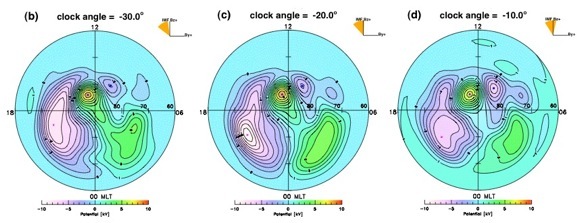
Fig. 1. Ionospheric potential patterns, derived from Cluster EDI measurements, for small clock angles regimes, illustrating the detail that can be resolved when mapping localised, small-scale, observations into a large-scale frame (from Föerster et al., 2008).
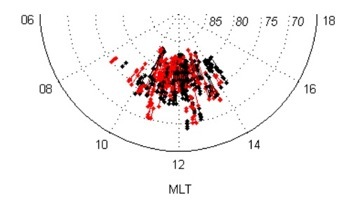
Fig. 2. The locations of cusp crossings observed by the Cluster satellites, projected onto a magnetic local time - invariant latitude grid, illustrative of a technique that enables data-sets from different physical regimes to be directly compared, from Pitout et al., (2006).
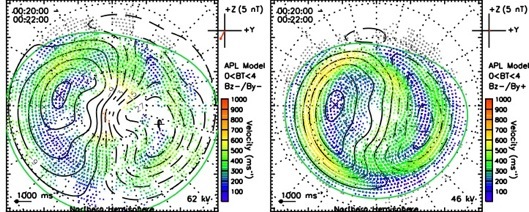
Fig. 3. Statistical convection patterns from the expansion phase of low onset-latitude (left) and high onset-latitude (right) magnetospheric substorms derived from a superposed epoch analysis of SuperDARN HF radar data. These data reveal the average nature of the convection for the two different categories of substorm, from Grocott et al., (2009).
One way to achieve a global picture from more localised measurements is to assimilate observations from one regime, or one spatial scale, into the regime of another. For example, Fig. 2 shows the locations of cusp crossings observed by the Cluster spacecraft, projected onto a magnetic local time - invariant latitude grid (Pitout et al., 2006, 2009). These data could then be directly integrated with ionospheric observations such as convection patterns or auroral images, enabling deductions about the average convection and auroral signatures of the cups to be made. In another example, electron velocity data from the Cluster Electron Drift Instrument has been mapped into the ionosphere and used to derive statistical maps of the high-latitude plasma convection (Haaland et al., 2007). This enabled similar statistical analyses from different instrumentation in different geophysical regimes to be directly compared and contrasted. This enabled convection features to be revealed in much greater detail relative to earlier studies, such as those made using the SuperDARN radars. It also showed that the measurements of total transpolar voltage exhibited a two-fold variation between the values derived using different techniques. These differences serve to further highlight the importance of, multi-scale statistical investigations in any attempt to fully characterise the M-I system.
Another way to achieve multi-scale analyses is by using multi-instrument techniques. For example, the Global Assimilation of Ionospheric Measurements (GAIM) uses a physics-based model of the ionosphere and neutral atmosphere, and a Kalman filter, as a basis for assimilating a diverse set of real-time (or near real-time) measurements (Schunk et al., 2004). The Assimilative Mapping of Ionospheric Electrodynamics (AMIE) technique, on the other hand, combines data from a wide range of sources such as radars, magnetometers and spacecraft to produce an optimal estimation of the high latitude electrodynamics (Richmond and Kamide, 1988). In a similar fashion, Amm et al. (1999) used a “method of characteristics” to obtain distributions of ionospheric conductance, actual ionospheric currents, and field-aligned currents (FACs). Using a combination of ground based magnetometer and radar measurements they were able to produce an instantaneous two-dimensional view of the ionospheric electrodynamics. Multi-instrument techniques can also be used to provide detailed information on the convection dynamics. For example, Hubert et al. (2006) combined radar data and spacecraft auroral imagery to derive time-dependent dayside and nightside reconnection rates, by determining both the motion of the boundary between open and closed field lines and the rate of flux transport across that boundary. On a related theme, identification of the poleward boundary of the auroral oval can often be problematic, even when derived from satellite-borne auroral imagers. In a study by Baker et al. (2000) poleward auroral emission boundaries from Polar Ultraviolet Imager (UVI) images were compared with precipitation boundaries from Defense Meteorological Satellite Program (DMSP) satellite spectrograms in order to better calibrate the boundary determination. Although multi-instrument studies have proved invaluable in any attempt to fully understand the dynamics of many geophysical processes, they tend to be applied on a case by case basis, often owing to the difficulty of obtaining large simultaneous and conjugate data-sets. However, as we discuss in the next section, we are now in a position where a number of suitable data-sets exist which, via the applications of appropriate assimilation methods, could help to provide a more complete generalised characterisation of many aspects of the coupled M-I system.
By way of an example, consider one major component of M-I dynamics: the magnetospheric substorm. Persistent disagreements exist over many aspects of substorm physics, such as whether or not substorms are responsible for the excitation of enhanced convection. Apparently contradictory observations have previously been reported to support both an enhancement, and reduction, in large-scale plasma convection during substorms (e.g. Grocott et al., 2002; Lyons et al., 2003; Bristow and Jensen, 2007). These contrary observations were recently reconciled, however, by a statistical study which used HF radar data to show that an enhancement is generally present, but is greatly dependent on the substorm onset-latitude (Grocott et al., 2009) (see Fig. 3). In related work, Milan et al. (2009) derived average global auroral images of the substorm cycle using much the same technique as Grocott et al. (2009) allowing their results to be directly compared. This provided additional information on the auroral dynamics, such as the existence of a relationship between the intensity of the auroral substorm bulge and the duration of a convection stagnation. This example illustrates the potential for the harmonisation of different theories that can be achieved by taking a statistical viewpoint. Clearly assimilating multiple data-sets into the averaging process provides much more information than single data-sets alone can provide and it is the intention of this proposal to apply such techniques to various targeted problems that have eluded explanation using traditional approaches.
References
Amm, O., M. J. Engebretson, R. A. Greenwald,et al., Direct determination of IMF BY-related cusp current systems, using SuperDARN radar and multiple ground magnetometer data: A link to theory on cusp current origin, J. Geophys. Res., 104, 17187–17198, 1999.
Baker, J. B., C. R. Clauer, A. J. Ridley, et al., The nightside poleward boundary of the auroral oval as seen by DMSP and the Ultraviolet Imager, J. Geophys. Res., 105, 21267–21280, 2000.
Bristow, W. A. and P. Jensen, A superposed epoch study of SuperDARN convection observations during substorms, J. Geophys. Res., 112, A06232, 2007.
Dungey, J.W., Interplanetary magnetic field and the auroral zones, Phys. Rev. Lett., 6, 47, 1961.
Föerster, M., S.E. Haaland, G. Paschmann, et al., High-latitude plasma convection during northward IMF as derived from in-situ magnetospheric Cluster EDI measurements, Ann. Geophys., 26, 2686-2700, 2008.
Grocott, A., S.W.H. Cowley, J.B. Sigwarth, et. al., Excitation of twin-vortex flow in the nightside high-latitude ionosphere during an isolated substorm, Ann. Geophys., 20, 1577-1601, 2002.
Grocott, A., T.K. Yeoman, S.E. Milan, and S.W.H. Cowley, Interhemispheric observations of the ionospheric signature of tail reconnection during IMF-northward non-substorm intervals, Ann. Geophys., 23, 1763-1770, 2005.
Grocott, A., S.E. Milan, and T.K. Yeoman, Interplanetary magnetic field control of fast azimuthal flows in the nightside hight-latitude ionosphere, Geophys. Res. Let., 35, GL033545, 2008.
Grocott, A., J.A. Wild, S.E. Milan, et al., Superposed epoch analysis of the ionospheric convection evolution during substorms: onset latitude dependence, Ann. Geophys., 27, 591, 2009.
Haaland, S.E., G. Paschmann, M. Foerster, et al., High-latitude plasma convection from Cluster EDI measurements: Method and IMF-dependence, Ann. Geophys., 25, 239 – 253, 2007.
Hubert, B. , S.E. Milan , A. Grocott, et al., Dayside and nightside reconnection rates inferred from IMAGE-FUV and SuperDARN data, J. Geophys. Res., 111, A03217, 2006.
Lyons, L.R., S. Liu, J.M. Ruohoniemi, J.C. Samson, and S.I. Solovyev, Observations of dayside convection reduction leading to substorm onset, J. Geophys. Res., 103, 1119, 2003.
Milan, S.E., A. Grocott, C. Forsyth, et al., A superposed epoch analysis of auroral evolution during substorm growth, onset and recovery: open magnetic flux control of substorm intensity, Ann. Geophys., 27, 659-668, 2009.
Øieroset, M., J. Raeder, T.D. Phan, et al., Global cooling and densification of the plasma sheet during an extended period of purely Northward IMF on October 22–24, 2003, Geophys. Res. Lett., 32, L12S07, 2005.
Østgaard, N., S.B. Mende, H.U. Frey, et al., Interplanetary magnetic field control of the location of substorm onset and auroral features in the conjugate hemispheres, J. Geophys. Res., 109, A07204, 2004.
Pitout, F., C.P. Escoubet, B. Klecker, and H. Rème, Cluster survey of the mid-altitude cusp: 1. size, location, and dynamics, Ann. Geophys., 24, 3011-3026, 2006.
Pitout, F., C.P. Escoubet, B. Klecker, and I. Dandouras, Cluster survey of the mid-altitude cusp - Part 2: Large-scale morphology, Ann. Geophys., 27, 1875-1886, 2009.
Reiff, P.H. and J.L. Burch, IMF By-dependent plasma flow and Birkland currents in the dayside magnetosphere 2. A global model for northward and southward IMF, J. Geophys. Res., 90, 1595, 1985.
Richmond, A.D., and Y. Kamide, Mapping electrodynamic features of the high-latitude ionosphere from localized observations: Technique, J. Geophys. Res., 93, 5741–5759, 1988.
Schunk, R. W., L. Scherliess, J.J. Sojka et al., Global Assimilation of Ionospheric Measurements (GAIM), Radio Sci., 39, RS1S02, doi:10.1029/2002RS002794, 2004.