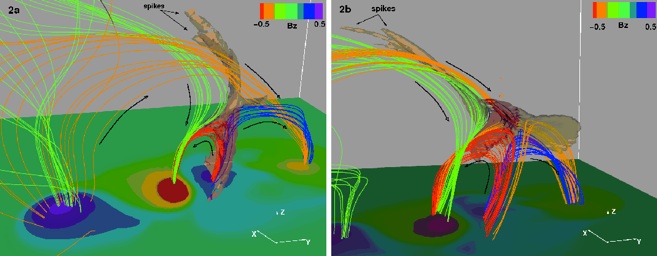
Magnetic Flux Emergence in the Solar Atmosphere: Comparing Observations and Model Conditions Leading to Active Regions Formation and to the Interaction of the Newly Emerged Flux with the Ambient Magnetic Field



The current model for the emergence of ARs on the solar surface assumes that they originate from the strong toroidal magnetic fields generated at the tachocline, at the base of the convection zone. When this flux get sufficiently buoyant it starts to rise, and eventually a small fraction of this flux will succeed in traversing the entire convection zone before reaching the solar atmosphere.
Observations show that flux emergence at the solar surface takes place continually and on a large variety of spatial scales, from small magnetic elements at the granular scale in the quiet Sun all the way up to large, complex active regions. This highly complex process affects essentially all atmospheric layers, from the photosphere to the corona. Therefore, flux emergence is a key element in understanding the physics of the Sun, both concerning the structure of the solar atmosphere as well as the processes in its interior responsible for the generation of the magnetic field.
The different origin of flux emergence episodes, large scale dynamo vs. surface dynamo process, leads to fluctuations at various spatial and time scales. The emergence of active regions appears to be hierarchical, highly-organized in its eleven-years cycle. Anyway temporal fluctuations are always present, like the present, long-lasting minimum of solar activity.
Important progress in our comprehension of the formation and evolution of ARs has been achieved in the recent decades thanks to multi-wavelength high-resolution observations of flux emergence events obtained both with ground-based instruments, such as the solar telescopes in Canary Islands (DOT; SST; THEMIS; VTT) and the DST telescope in the United States, and with the space-based observations performed by the instruments on board satellites (SOHO, TRACE, RHESSI, HINODE).
Thanks to these observations, it is now possible to provide a very detailed scenario about the phenomena observed in the early evolutionary phases of an AR: plasma motions, pore formation, arch-shaped structures appearance (named Arch Filament System or AFS), coalescence phenomena of small-scale field concentrations. Despite that, it is not possible to forecast, during the very first evolutionary phases of an AR, whether it will go through a complete evolution (with a mean lifetime of ~ 1 – 2 months), or it will spread away in a short time (1 – 7 days).
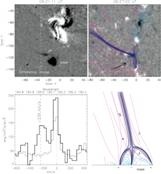
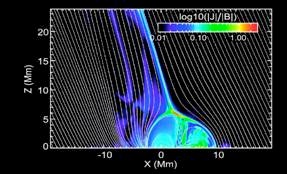
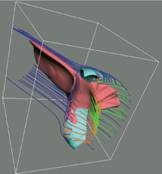
Comparison between observations and models. Left panel mosaic: Coronal jet observed in an equatorial coronal hole on March 10, 2007. Top left: difference XRT Open/Ti poly image of the jet. Top right: MDI magnetogram and linear force free magnetic field extrapolation. Bottom left: Fe XII 195.1 Å spectral profile at the jet location (thick line) at 06:21 UT. Bottom right: side view as indicated by the black arrow in the panel above. Middle panel: a 2D slice of a 3D MHD experiment simulating the emergence of flux into a slanted coronal field. Right panel: A full 3D view of the structure of the magnetic field. For more details see Moreno-Insertis et al., 2008, Astrophysics Journal, 673, L211.
Moreover, an important aspect of the magnetic flux emergence in the solar atmosphere concerns its interaction with the ambient magnetic field. This interaction, that may lead to magnetic reconnection, is believed to be responsible for significant energy release in the form of particle acceleration, plasma heating and bulk kinetic energy that can cause impulsive phenomena, for example brightenings, jets and surges, and large explosive events such as flares, eruptive prominences and CMEs.
This widely accepted scenario has received significant support over the last few years from several numerical models including physical features such as radiative transfer and partial ionization and by extending the computational domain from the convection zone up to the corona. This has allowed the first investigations of the interaction of the magnetic flux, brought into the atmosphere by magnetic buoyancy, with the pre-existing ambient field in the various atmospheric layers in the emergence site.
Scientific Rationale