




Listed are all scientific papers resulting from an ISSI activity written or co-authored by ISSI Team members, Working Group members, Workshop participants, visitors or staff members.
Accurate uncertainty information associated with essential climate variables (ECVs) is crucial for reliable climate modeling and understanding the spatiotemporal evolution of the Earth system. Recent developments in deep learning have remarkably advanced the estimation of ECVs with improved accuracy. However, the quantification of uncertainties associated with outputs of such deep learning models has yet to be widely adopted.
Mercury’s surface, as revealed by the MESSENGER probe, lacks distinctive absorption features in the visible–near-infrared spectral range, except for hollows that display a 630 nm feature ascribed to sulfides. The general absence of spectral features makes inference of its surface mineralogical composition challenging. We inspected the Praxiteles impact basin with newly photometrically corrected MDIS data, removing the influence of topographic shading in the spectra.
Bright points (BPs) are small-scale, dynamic features that are ubiquitous across the solar disc and are often associated with the underlying magnetic field. Using broadband photospheric images obtained with the Visible Broadband Imager at the National Science Foundation’s Daniel K. Inouye Solar Telescope (DKIST), the properties of BPs have been analyzed with DKIST for the first time at the highest spatial resolutions achievable.
Electrons of several hundred keV in Saturn’s ring current are important seed components of the radiation belt. In this study, we have statistically analyzed the spatial distribution of energetic electrons on the equatorial plane of the inner magnetosphere based on the Cassini in situ observations. We found for all energy channels, the peak position of energetic electron flux shifts from the midnight sector to the afternoon sector as L shell increases.
Cosmic magnetic fields are typically inhomogeneous and often highly tangled due to large-scale plasma flows, turbulence, and instabilities. If the variations in the magnetic field occur on scales that are large compared to the gyro-radius of the plasma electrons, the electrons are primarily confined to gyro-centre trajectories along the field lines. Therefore, in-situ electron measurements help us map out the connectivity of the magnetic field in space plasmas.
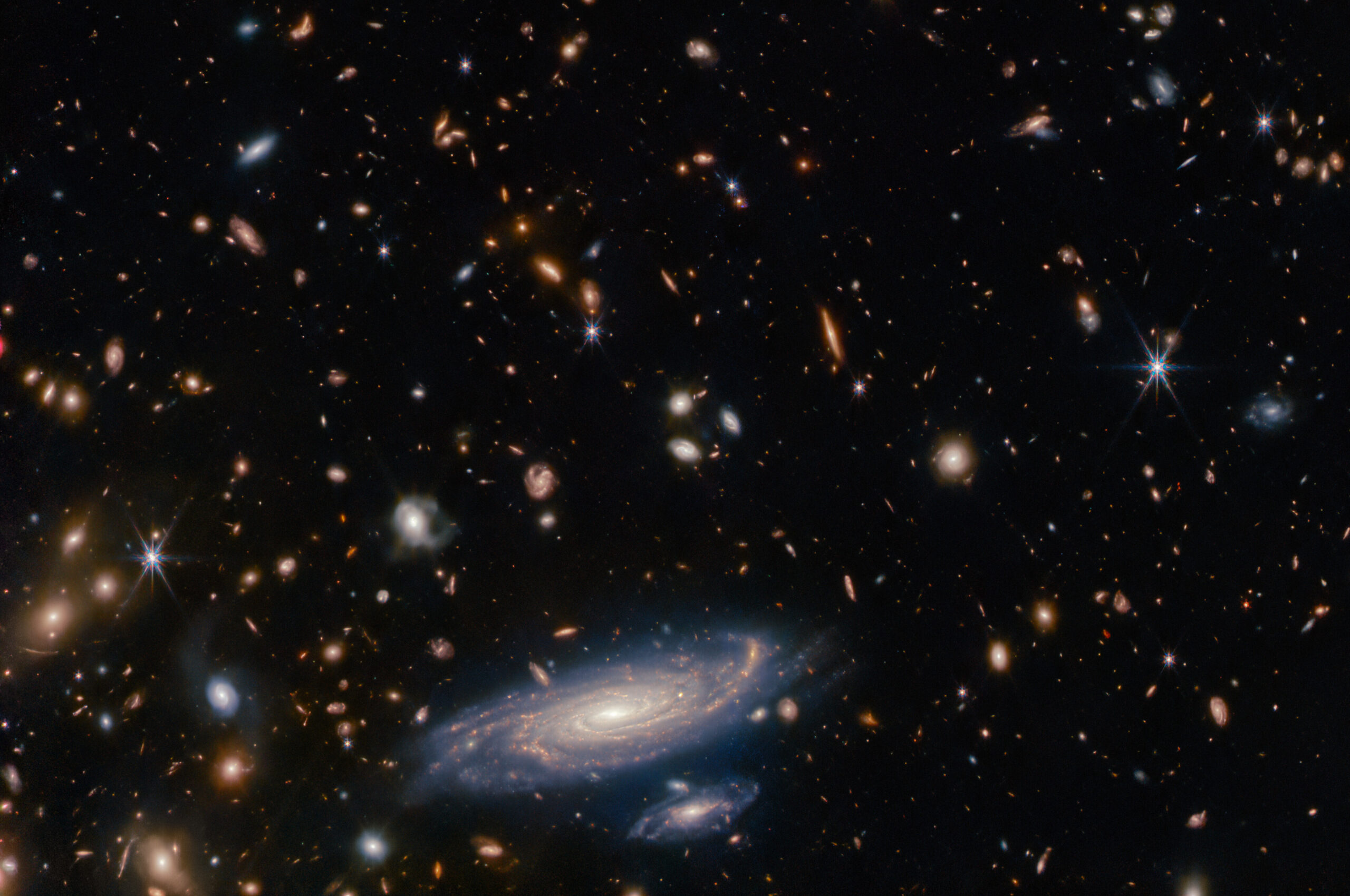
We present the Parallel Application of Slitless Spectroscopy to Analyze Galaxy Evolution (PASSAGE) spectroscopic redshift catalog in the COSMOS field. PASSAGE is a JWST Cycle 1 Near Infrared Imager and Slitless Spectrograph (or NIRISS) wide-field slitless spectroscopy pure-parallel survey, obtaining near-infrared spectra of thousands of extragalactic sources.
Radio bursts with zebra patterns (hereafter ZP bursts) are the most intriguing coherent emission produced by nonthermal electrons, which have been recorded frequently on the dynamic spectrograms of the Sun, Jupiter, Saturn, and even supernova remnants.
Parker Solar Probe observations in the young solar wind reveal new properties of both plasma particle velocity distributions (VDs) and associated electromagnetic (EM) wave fluctuations. The quasilinear (QL) kinetic theory of plasma wave instabilities has recently shown that new hammerhead (HH) proton distributions can be generated by the relaxation of proton beams through the instabilities of right-handed (RH) polarized waves.
We have measured the absolute doubly differential angular sputtering yield for 20 keV Kr+ impacting a loose Cu powder at an incidence angle of θi = 45°. We find that ion sputtering from a loose Cu powder differs dramatically from a flat Cu slab under the same irradiation conditions, being most pronounced for the angular distribution. The ejecta lobe for the powder is directed primarily backward, relative to the ion velocity vector.
With recent observational advancements, exocomet studies have entered a new era: we have moved from an epoch where exocomets’ signatures were analysed to identify their true nature to a new epoch where individual exocomets’ detections are studied in detail to characterise the observed bodies. In this context, as with other astronomical objects such as exoplanets and minor bodies in the solar system, a nomenclature system is needed to uniquely identify any observed exocometary body.