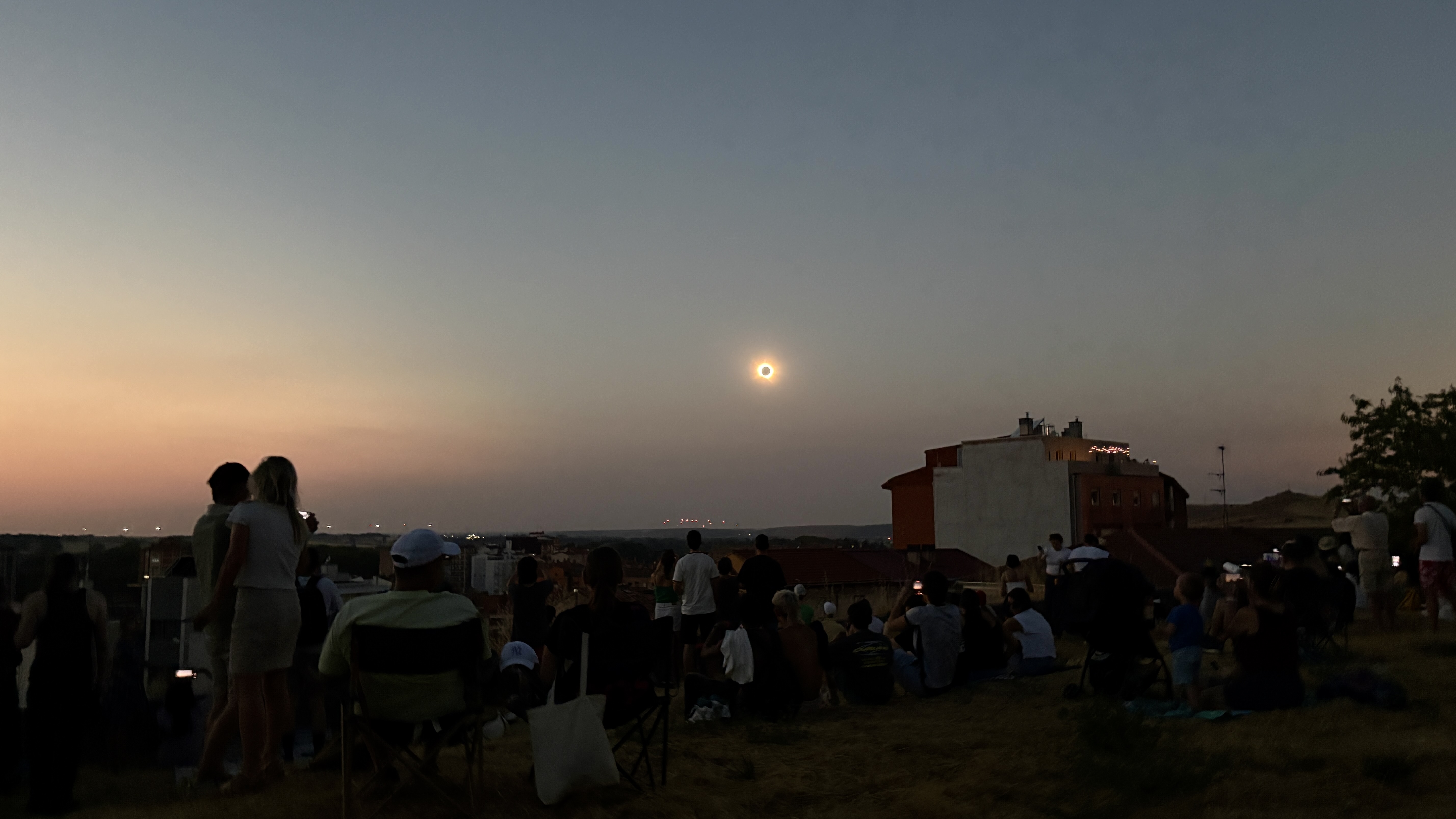
I arrived near Burgos during the afternoon of August 12. I chose an elevated location with a clear view of the horizon, as this would allow me to keep the Sun in sight for as long as possible before it set, and therefore extend the time I could observe the eclipse. Hundreds of people had gathered in the place, coming from everywhere. During the time before the eclipse, I spoke with Spanish, Polish, Slovenian, and German observers, among many others.
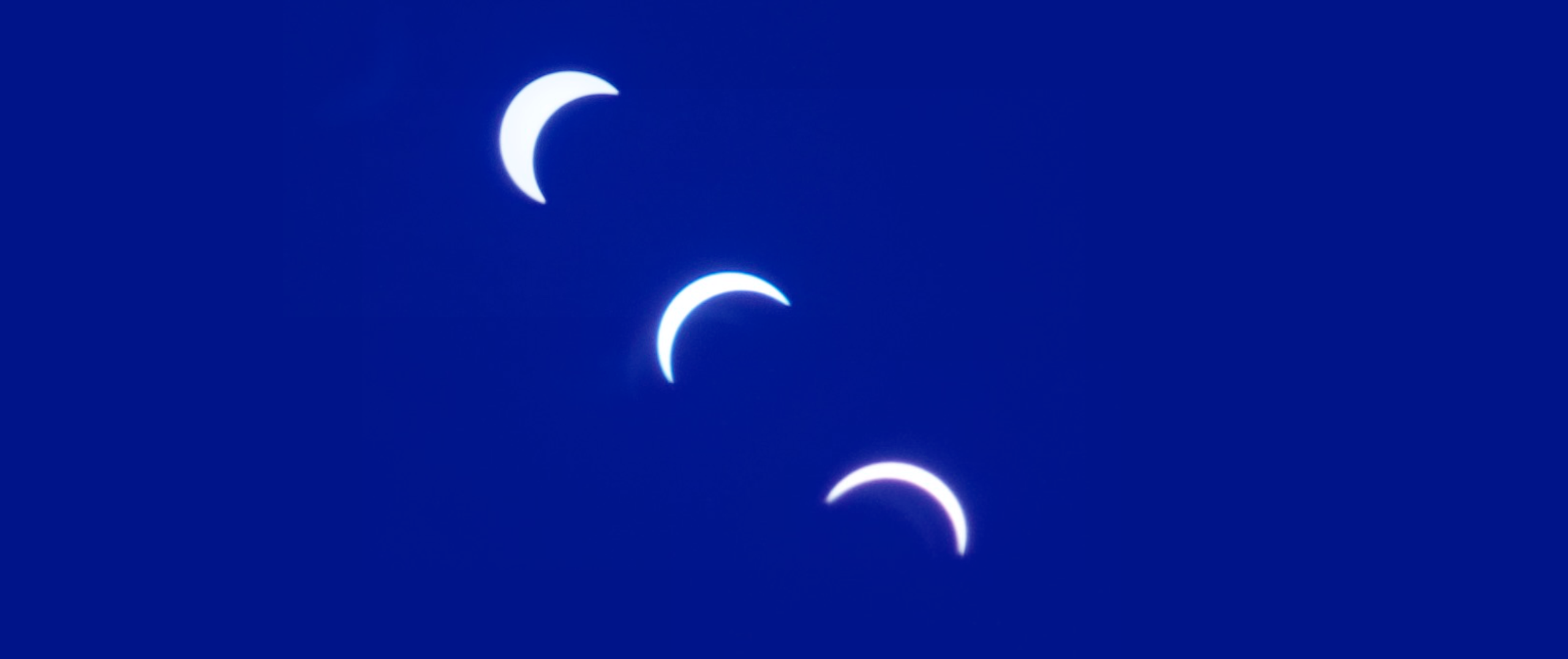
And then, shortly after 7:30 pm, the Moon began to move across the face of the Sun. For nearly an hour, we watched the Moon progressively cover the solar disk. The temperature remained close to 40°C and standing in direct sunlight for such a long time was not particularly comfortable. As more and more of the Sun was obscured, the ambient light began to change noticeably. The landscape took on an increasingly unusual appearance, with visible reduction in direct sunlight. Then, suddenly, the transition became much faster: the sky darkened within seconds.
The hundreds of people around me started shouting and applauding, and the scientific event happening above us became something much more human. This is the moment when a solar eclipse stops looking like an eclipse. The bright solar disk vanished, leaving only the solar corona visible around the black silhouette of the Moon. To the naked eye and for non-experts, the visual appearance was almost reminiscent of a black hole surrounded by a luminous disk.
The structure of the corona was also clearly visible. It was not simply a perfectly uniform halo. Its irregular shape reflected the complex structure of the Sun’s magnetic field. In my photographs, one can even distinguish a darker region corresponding to a coronal hole towards the lower-left side of the corona. The Sun suddenly looked less like the familiar bright disk we see every day and more like a complex astrophysical object.
The totality lasted approximately one minute and forty seconds at our location, which sounds like a long time when written down. In reality, it felt closer to thirty seconds.
One of the things I had particularly hoped to see was the movement of the Moon’s shadow across the landscape: the shadow of a total solar eclipse is a relatively small region of the Earth’s surface moving rapidly along the eclipse path. Its speed can reach roughly 1,700 km/h, depending on the location and stage of the eclipse. I had even prepared a drone to try to capture the phenomenon from above, but unfortunately, I could not consciously perceive the shadow racing across the landscape. we mainly saw the environment become darker within just a few seconds.
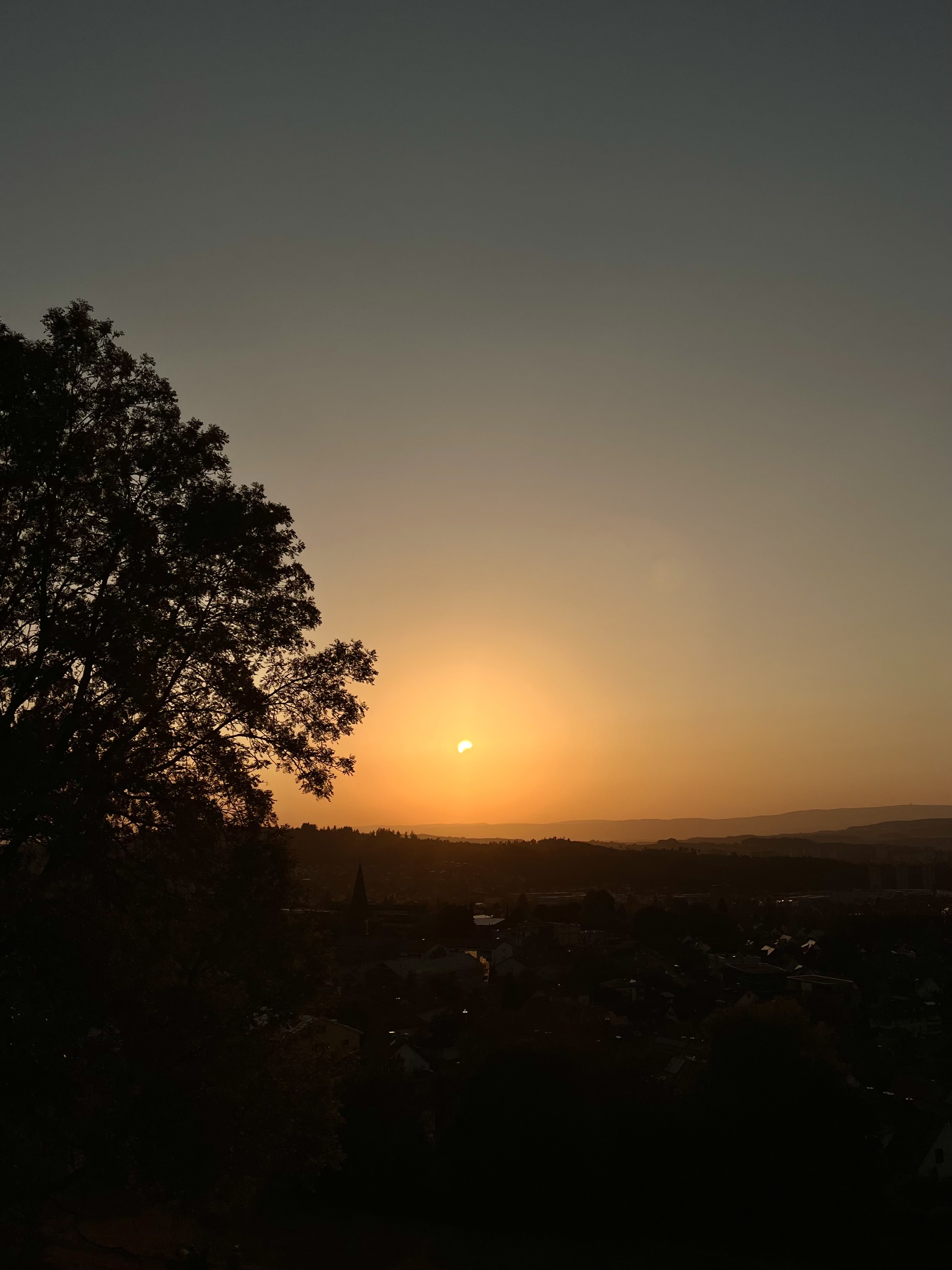
The first rays of sunlight reappeared from behind the Moon. Almost immediately, everyone put their eclipse glasses back on. The extraordinary darkness disappeared as quickly as it had arrived, and the partial eclipse resumed. It therefore continued almost all the way to the horizon, with the remaining crescent of the Sun gradually sinking towards sunset. Eventually, the Sun disappeared completely below the horizon, at roughly the same time as the Moon was finishing its passage across the solar disk.
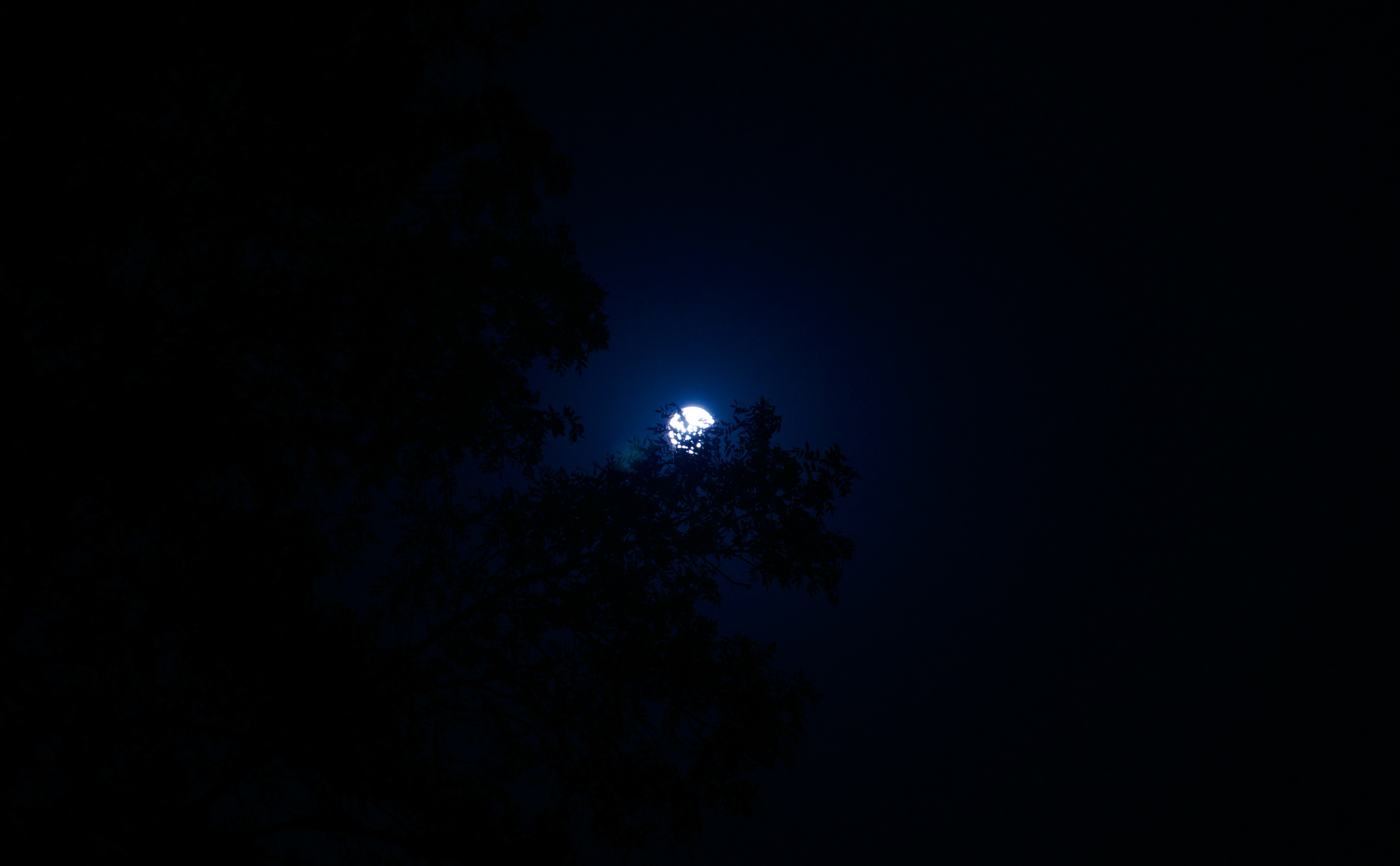
That night, some of the people I had met decided to stay where they were and sleep under the stars. There was another reason to remain outside: the Perseid meteor shower was reaching its peak on the same night. However, I had to drive back to Switzerland.
And the story does not end here. In less than a year, another total solar eclipse will cross the Mediterranean, passing through Spain and then across North Africa. With a maximum totality of more than six minutes, the 2 August 2027 eclipse will be the longest total solar eclipse of the 21st century.
And I, I will be there again.