




An ISSI International Team analysed multi-planet systems and found that they split into two distinct families born around different types of stars. The study, published in Nature Astronomy, shows for the first time that the host star’s properties determine the architecture and dynamical evolution of the entire planetary system.
BERN, SWITZERLAND – Analysing a sample of three hundred of the best-characterised planetary systems among the over one thousand known in the Milky Way, the ISSI International Team has discovered that the multi-planet systems identified so far belong to two distinct “families”. The study, published today in Nature Astronomy, demonstrates for the first time a true “genetic link” between the host star and its planets that shapes the birth, dynamical evolution, and future stability of the entire planetary system.
An international team led by ISSI and the University of Bern has used high-resolution, computer simulations and comparisons with the latest images from the ESA space probe Herato show that a single asteroid impact shaped the Martian moon Deimos and created its smooth, dusty surface. This is the first scientific publication to use data from the ESA space probe Hera flyby of Deimos and provides an important foundation for future space missions, such as the MMX mission of the Japan Aerospace Exploration Agency (JAXA).
BERN, SWITZERLAND – Deimos, the smaller and outermost of Mars’ two moons, is roughly oval in shape and has a deep depression at its south pole. Unlike its heavily scarred sister moon, Phobos, Deimos is covered by a loose layer of dust and rubble – a so-called regolith layer – which gives it a smoother, dustier appearance. Although numerous space probes have provided increasingly detailed images of its surface over the past decades, the origin of the debris layer and the depression at the south pole remains unclear.
This is where a new study by an international research team comes in, led by Dr. Sabina Raducan, in collaboration with, among others, the Observatoire de la Côte d’Azur, the University of Arizona, and the University of Tokyo. Raducan was a researcher in the Division of Space Research and Planetary Sciences (WP) at the Physics Institute at the University of Bern until October 2025 and is now Science Programme Manager at the International Space Science Institute (ISSI) and a Senior Fellow at the Vrije Universiteit Brussel. Using state-of-the-art computer simulations from the “Bern Smoothed Particle Hydrodynamics (SPH)” code, the researchers were able to show that the distinctive depression near Deimos’s south pole was most likely formed by a single, non-destructive asteroid impact. This impact is also believed to have created the regolith layer present on Deimos. The study is the first scientific publication to use data from the flyby of Deimos by the ESA space probe Hera, which is currently en route to the distant asteroid moon Dimorphos. The study was published in Nature Astronomy.
A community-built distance network sharpens the Hubble constant and broadens the evidence behind the “Hubble tension”.
BERN, SWITZERLAND – An international collaboration of astronomers has achieved the most precise direct measurement to date of the current expansion rate of the Universe. In a paper to be published in Astronomy & Astrophysics, the H0 Distance Network (H0DN) Collaboration reports a value of the Hubble constant of
H₀ = 73.50 ± 0.81 km s⁻¹ Mpc⁻¹, corresponding to a precision of just over 1%.
The study, “The Local Distance Network: a community consensus report on the measurement of the Hubble constant at ∼1% precision,” is the outcome of a broad community effort launched at the ISSI Workshop “What’s under the H0od?”, held at the International Space Science Institute (ISSI) in Bern in March 2025.
ISSI warmly congratulates Claire Nichols, ISSI Johannes Geiss Fellow 2026, on the publication of her new paper in Nature Geoscience: “An intermittent dynamo linked to high-titanium volcanism on the Moon.”
The study, led from the University of Oxford and based on analyses of samples returned by the Apollo program, resolves a decades-long debate about the strength of the Moon’s ancient magnetic field.
A new study using data from NASA’s Lucy mission reveals that the asteroid Dinkinesh’s tiny moon “Selam” was built from multiple low-speed collisions between small moonlets, making it the first confirmed “contact binary” moon. Scientists now believe Selam formed not from two, but at least four separate bodies, offering fresh insight into how asteroid moons form and evolve.
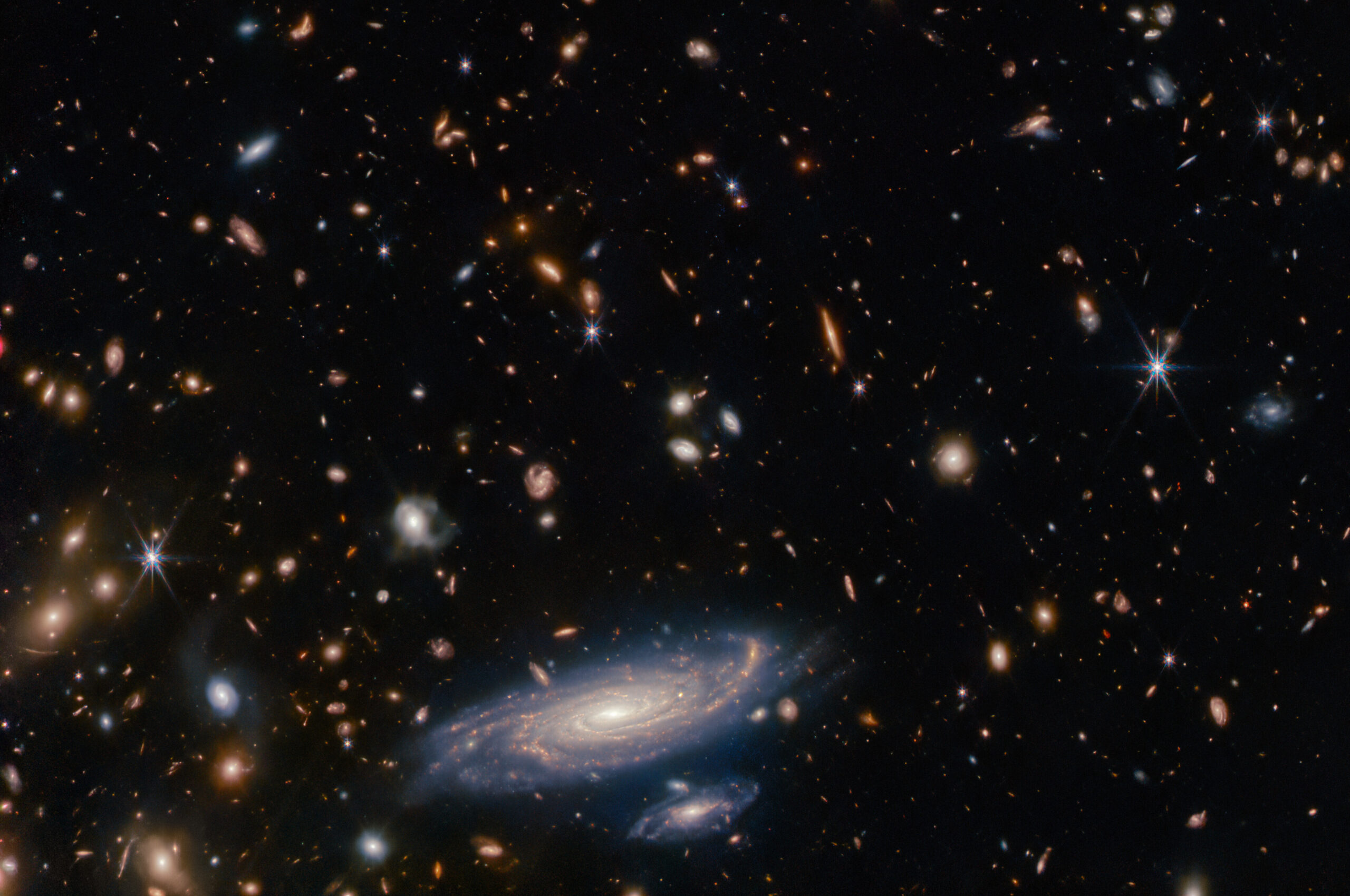
A new Perspective published in Nature Astronomy provides the most comprehensive snapshot yet of the Universe’s first Billion years, as revealed by the James Webb Space Telescope (JWST). Drawn from the collective insights of an international assemblage of leading astronomers, the work charts a transformative moment in cosmic research—an era where science textbooks are being rewritten in real time.
A groundbreaking new study led by Marta Marcos, Discipline Scientist at the International Space Science Institute (ISSI), has revealed that the number of extreme marine heatwave days has nearly tripled since the 1940s—a dramatic shift driven largely by human-induced climate change.
Scientists supported by the International Space Science Institute (ISSI) in Bern have found that while Titan’s subsurface ocean could theoretically support microbial life through glycine fermentation, the availability and transport of organic material likely limit any potential biosphere to only a few kilograms of biomass.
An international team of astronomers has used the NASA/ESA/CSA James Webb Space Telescope to detect the first rich population of brown dwarf candidates outside the Milky Way in the star cluster NGC 602.