








Press release
Asteroid impact shaped the appearance of Mars’ moon Deimos
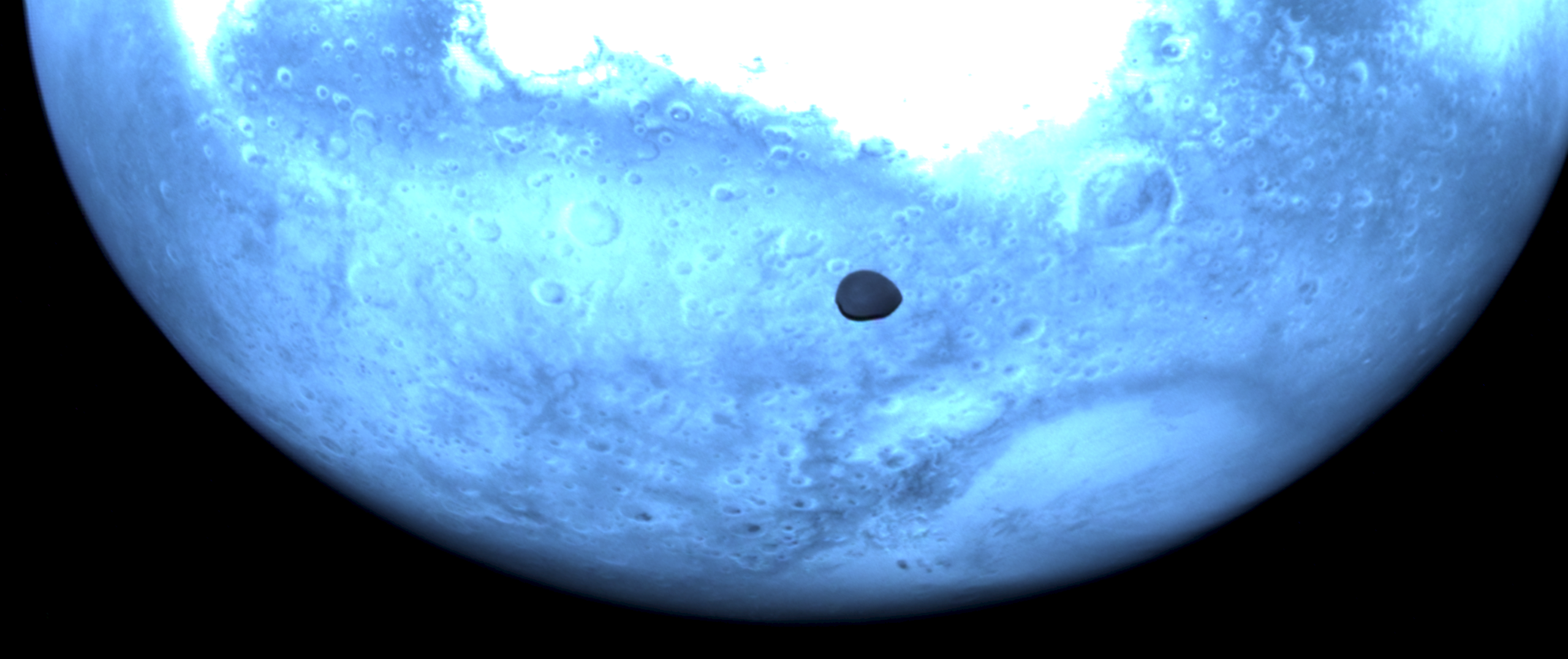
An international team led by ISSI and the University of Bern has used high-resolution, computer simulations and comparisons with the latest images from the ESA space probe Herato show that a single asteroid impact shaped the Martian moon Deimos and created its smooth, dusty surface. This is the first scientific publication to use data from the ESA space probe Hera flyby of Deimos and provides an important foundation for future space missions, such as the MMX mission of the Japan Aerospace Exploration Agency (JAXA).
BERN, SWITZERLAND – Deimos, the smaller and outermost of Mars’ two moons, is roughly oval in shape and has a deep depression at its south pole. Unlike its heavily scarred sister moon, Phobos, Deimos is covered by a loose layer of dust and rubble – a so-called regolith layer – which gives it a smoother, dustier appearance. Although numerous space probes have provided increasingly detailed images of its surface over the past decades, the origin of the debris layer and the depression at the south pole remains unclear.
This is where a new study by an international research team comes in, led by Dr. Sabina Raducan, in collaboration with, among others, the Observatoire de la Côte d’Azur, the University of Arizona, and the University of Tokyo. Raducan was a researcher in the Division of Space Research and Planetary Sciences (WP) at the Physics Institute at the University of Bern until October 2025 and is now Science Programme Manager at the International Space Science Institute (ISSI) and a Senior Fellow at the Vrije Universiteit Brussel. Using state-of-the-art computer simulations from the “Bern Smoothed Particle Hydrodynamics (SPH)” code, the researchers were able to show that the distinctive depression near Deimos’s south pole was most likely formed by a single, non-destructive asteroid impact. This impact is also believed to have created the regolith layer present on Deimos. The study is the first scientific publication to use data from the flyby of Deimos by the ESA space probe Hera, which is currently en route to the distant asteroid moon Dimorphos. The study was published in Nature Astronomy.