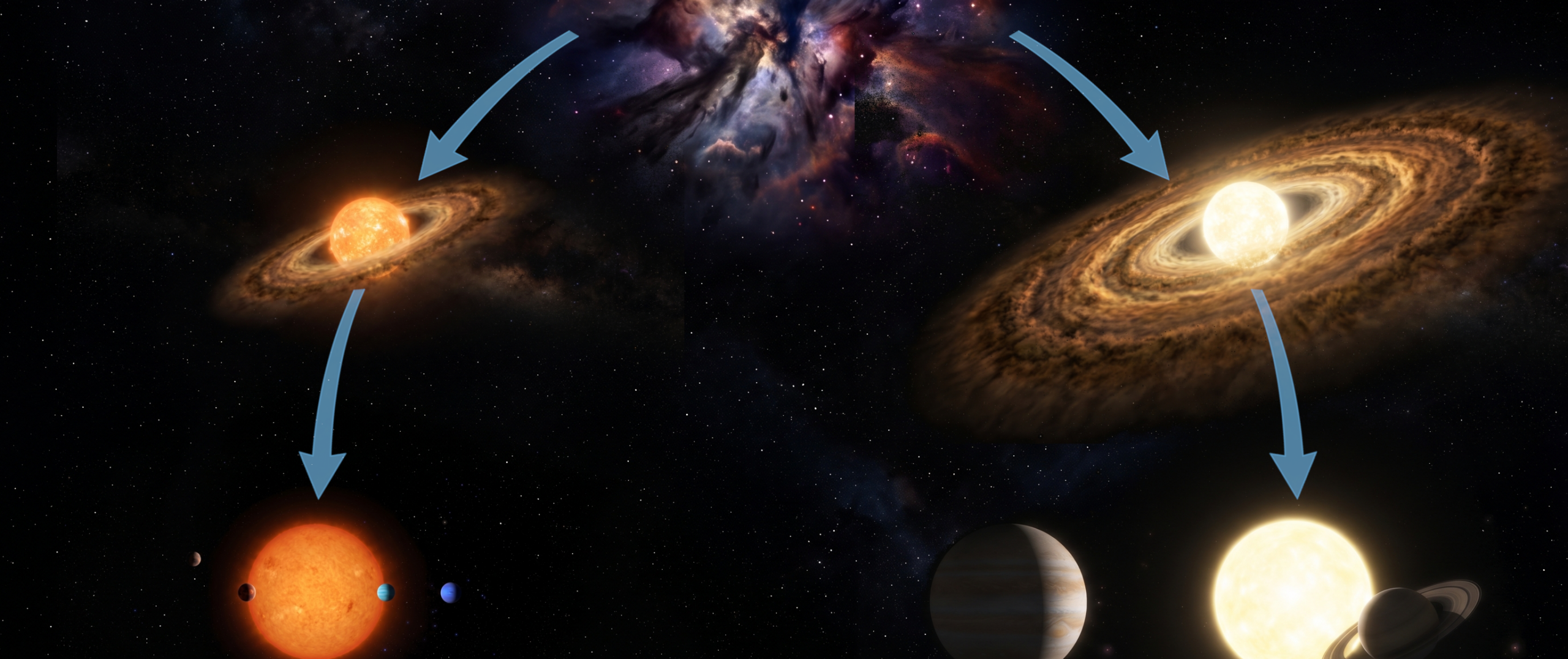
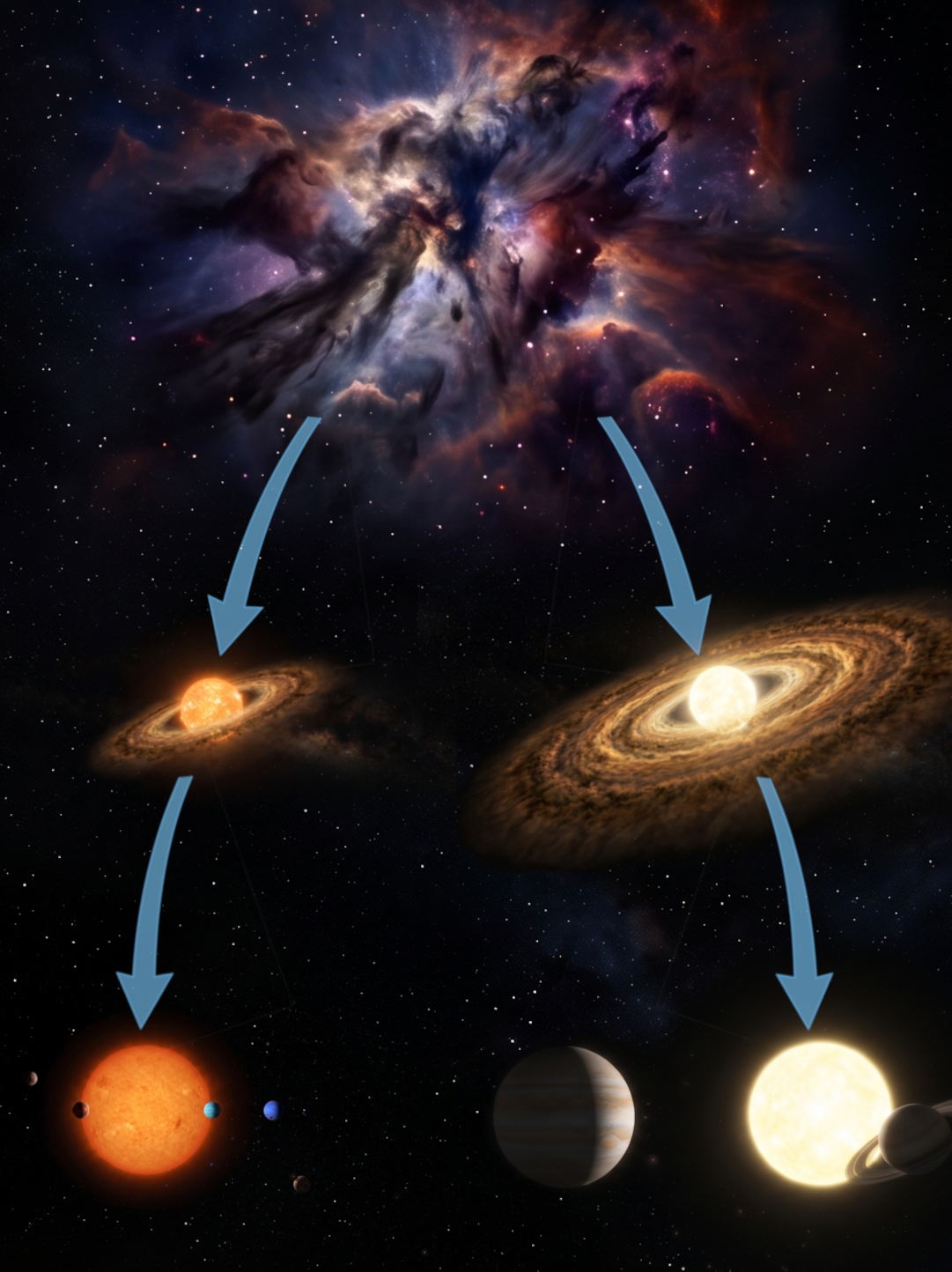
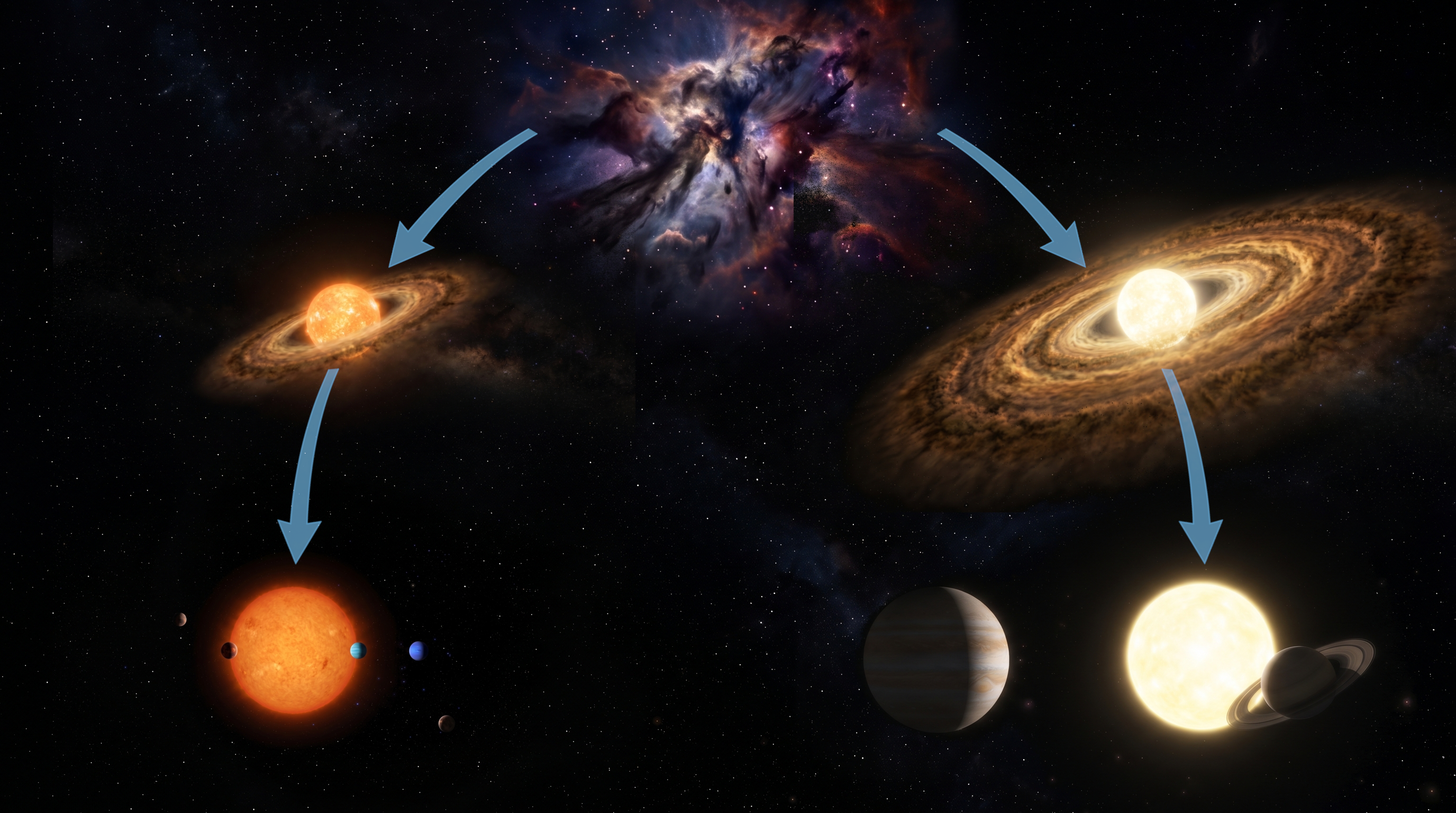
The first family consists of wide, massive systems, often with total masses between twice and ten times that of the Solar System, orbiting stars more massive and metal-rich (i.e., elements other than hydrogen and helium) than our Sun. The second family instead includes compact and lower-mass systems, consisting of planets with comparable masses and sizes – in a configuration known as “peas-in-a-pod” – which orbit stars with mass and metallicity equal to or lower than those of the Sun at distances that, in most cases, are much tighter than those of Mercury in the Solar System.
To distinguish them, the researchers used a series of parameters that allow the comparison of the characteristics of such different systems. For example, the first family systems have a high “dynamical temperature”. Measured by a parameter that quantifies the system’s deviation from an unperturbed configuration with all circular orbits in the same plane, this characteristic traces a past marked by violent gravitational instabilities, giant collisions, and planetary ejections. The members of the second family, by contrast, show traces of less violent dynamical histories, closer to our Solar System.
“The fundamental question we started from was: what determines the characteristics of planetary systems as we see them today? Are they established at birth or sculpted by evolution over time? The truth, in the end, turned out to lie somewhere in the middle,” explains Diego Turrini, INAF researcher and co-first author of the article. “Our results show that there is a genetic link between planetary systems and their stars, and that, depending on the star around which they are born, this link also determines their fate.”
Even modest variations in the planetary formation environment, due to different stellar properties, can radically change the nature of the forming system and its future evolution, determining whether it will be characterised by phases of marked instability and giant impacts.
“The main difficulty during the data analysis was determining whether the two families of planetary systems were real or just an illusion created by the technological limits of current observational techniques,” adds Camilla Danielski, researcher at the University of Valencia and former INAF postdoctoral fellow, co-first author of the work. “At the end of the path, it became clear that selection effects acted as the tip of the iceberg, revealing the existence of much deeper structural diversities between these systems.”
To prove this hypothesis, a series of numerical simulations exploring the evolution of planetary systems with different initial conditions were also essential. “The scenarios that best reproduce the dynamical properties of the family of wide and massive systems are those in which the systems are unstable from birth,” emphasises Danae Polychroni, an INAF researcher who supervised this part of the study. “The greater abundance of material from which planets form around their host stars causes them to be born too large, preventing the system from remaining stable.”
The discovery clarifies how the native stellar environment directly affects planetary fates and the survival of worlds potentially capable of hosting life. Understanding this link is essential to guiding the search for planetary architectures similar to the Solar System and for potentially habitable planets like Earth.
The study, led by INAF researchers and supported by the International Space Science Institute (ISSI) in Bern through the “Transformation of Planetary Systems by Environmental Perturbations” project led by Diederik Kruijssen, sees the participation of a large international collaboration with the University of Valencia, the Italian Space Agency (ASI), the Centrum Badań Kosmicznych PAN, Uppsala University, and several European universities.