Search

International Space Science Institute (ISSI)Hallerstrasse 6
3012 Bern
Switzerland

Phone +41 31 684 48 96

Highlights and Nuggets

Contributions from Fabio Crameri

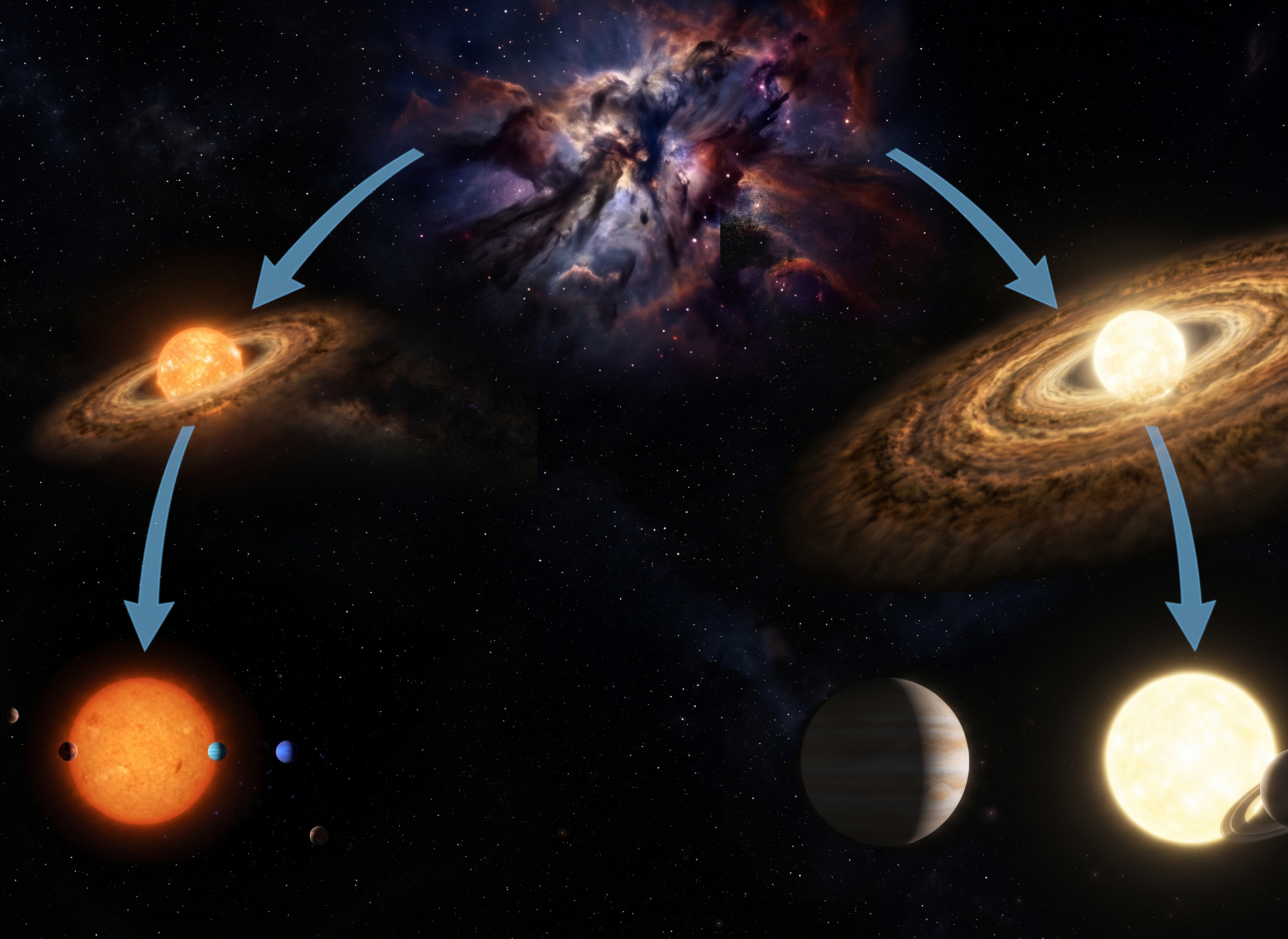
Schematic illustration of the genetic link between stellar properties and planetary system architectures. Different star-forming environments produce stars and protoplanetary discs with different masses and heavy-element abundances, which in turn shape the architectures of the multi-planetary systems born therein. Lower-mass, subsolar-metallicity stars tend to host compact systems with lower levels of dynamical excitation, populated by smaller but more numerous planets (left). In contrast, higher-mass stars with solar to super-solar metallicities tend to host systems with fewer, more massive planets on wider orbits. These systems are more dynamically excited, likely due to gravitational instabilities that can eject some of the originally formed planets (right). Credits INAF / Universitat de Valencia / image generation assisted by Gemini AI.

Planetary systems, two distinct families: The host star leaves its signature

Press release

byMarco Galliani (INAF)Eleonora Ferroni (INAF)Llum Catalán Peñuelas (UV)

Published: 13 October 2026

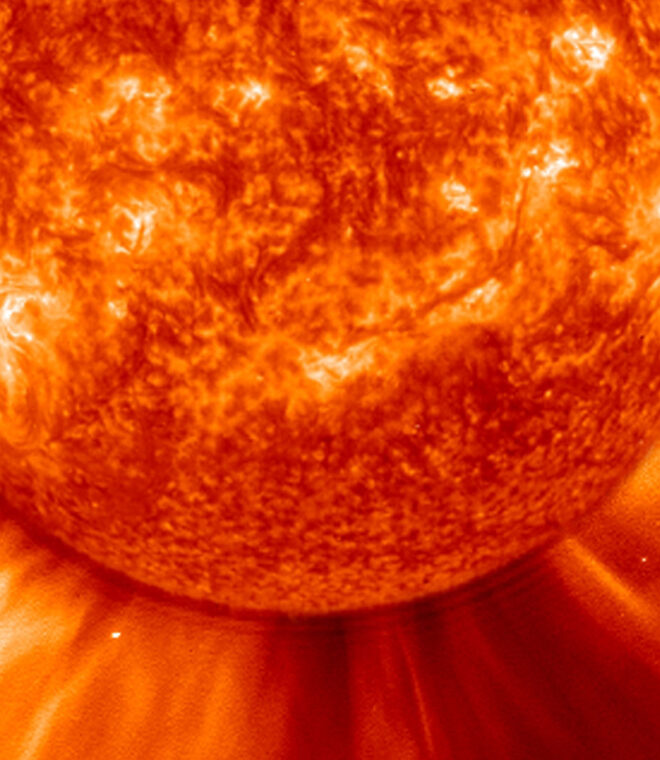
Image: ESA & NASA/Solar Orbiter/EUI team; Data processing: E. Kraaikamp (ROB)