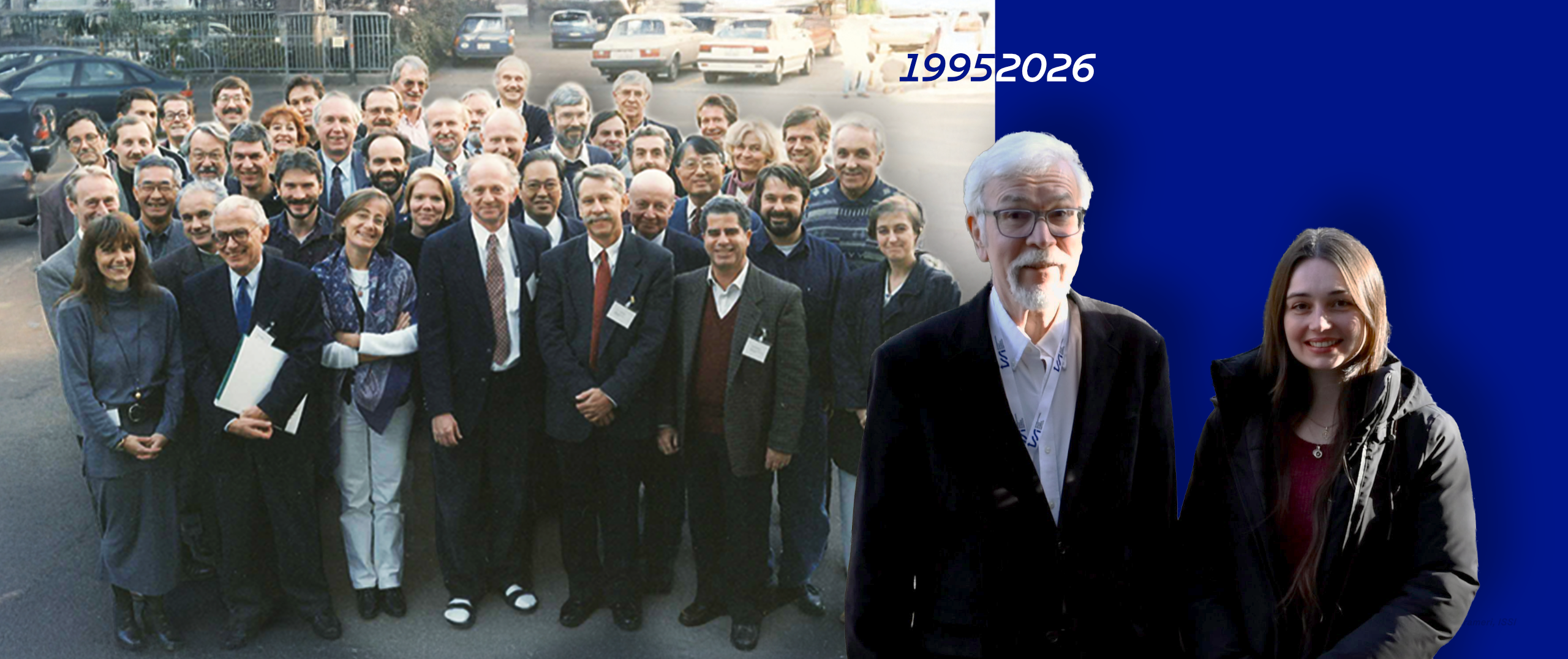
For Professor emeritus Eberhard Möbius (University of New Hampshire), ISSI is not just a venue but a constant companion throughout his career. He participated in ISSI’s very first workshop in 1995 together with Johannes Geiss, the founding father of ISSI. A moment captured in a team photo showing, as Möbius jokes, “significantly less white hair”.
Since then, he has led two ISSI International Teams, held a sabbatical at ISSI, and returned for multiple visiting scientist stays. His own career path mirrors ISSI’s international spirit: beginning in Bochum, Germany, moving to the Max Planck Institute for Extraterrestrial Physics in 1978, and then, after a family discussion weighing life in Europe versus the US, relocating to the University of New Hampshire in 1990.
Across the pond but not off the table, Möbius continued long-standing collaborations with Johannes Geiss and colleagues around the world that began in the mid 1980s, bridging heliospheric physics and astrophysics. Over the past 30 years, he has witnessed — and helped drive — progress in understanding the heliosphere, the interstellar medium, and the interconnected shields formed by the heliosphere, Earth’s magnetosphere, and the atmosphere.
Today, his work within the IMAP mission (and passion for it: he is wearing an IMAP-branded shirt) continues to address fundamental questions about where we come from and how cosmic radiation has shaped Earth’s history. These are questions that now sit alongside the growing societal importance of space weather, as modern technological systems vulnerable to solar storms become ever more present.
Asked about his favourite part of ISSI, Möbius does not hesitate: the coffee machine. It is there, he says, that conversations begun in the Johannes Geiss Meeting Room are refined, challenged, and transformed into new scientific ideas; a reminder that progress often happens between sessions as much as during them.
His advice to early-career scientists is simple but profound: specialise deeply, but never stop looking beyond your own plate. “In the space between disciplines,” he says, “there is a lot of room for progress.” Making mistakes, and asking difficult questions – even those likely to lead to negative results – are all part of doing science properly.