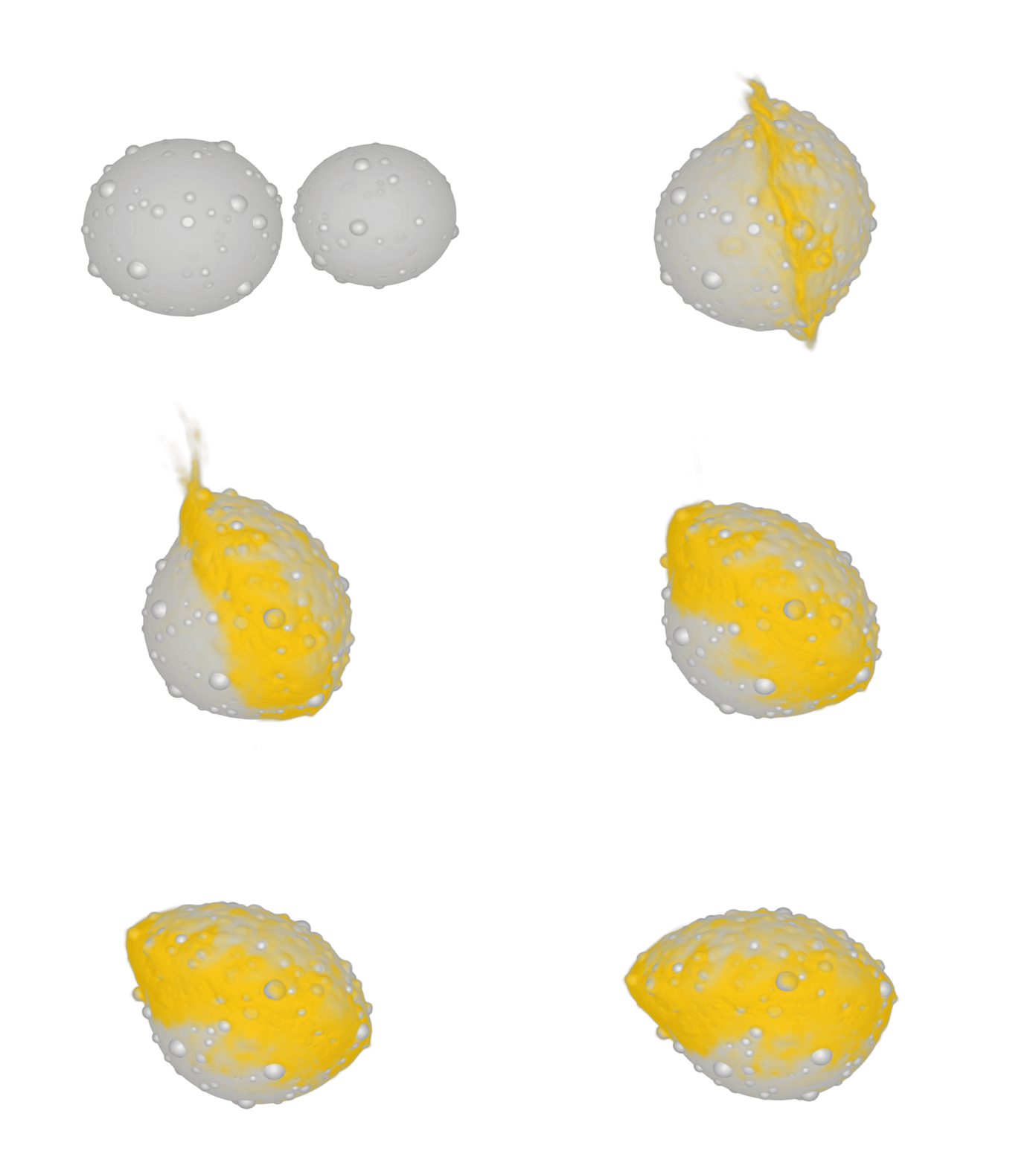
BERN, SWITZERLAND – Selam, which orbits the main-belt asteroid Dinkinesh, was spotted during Lucy’s flyby in November 2023. Its unusual, two-lobed shape immediately stood out. Published today in Nature Communications, the new study shows Selam likely formed through at least four slow-motion collisions of similar-sized “moonlets”, a process that assembled the moon’s two lobes over time like a jigsaw puzzle.
Computer simulations led by Sabina Raducan of the University of Bern and the International Space Science Institute (ISSI) showed these low-speed mergers could produce Selam’s distinct ridge and double-lobed appearance. “These collisions happened at such low velocities that the pieces didn’t shatter but stuck together,” said Raducan, the study’s corresponding author. “It likely took at least four of these slow impacts for Selam to accumulate into the two-lobed body we see today.”
Selam is now recognised as the first contact binary moon imaged up close. In Lucy’s spacecraft’s initial photos, the two lobes appeared almost one behind the other, but as more data came in, the mission team realised the tiny moon was actually composed of two connected chunks. That discovery was a surprise: astronomers previously expected asteroid moons to be single, elongated rocks, but Selam’s peanut-like form has upended those assumptions. “Selam shows that nature can create moons in more creative ways than we’d anticipated, and it’s the first proof that such unusual moons exist,” Raducan said.
The study also suggests broader implications for planetary science and asteroid deflection strategies. The authors note that Dimorphos (the target of NASA’s 2022 DART impact mission) may have formed through a similar process. Understanding what these small asteroids formed and what are made of is essential for designing future planetary defense missions.
This study places Selam’s formation in the context of how binary asteroids evolve. Scientists suspect spinning asteroids can shed material that forms multiple mini-moons, which may later merge in sequence. This process could lead to a wide variety of satellite shapes. “Selam might be just the tip of the iceberg,” Raphael Marschall, ISSI Science Program Manager and co-author on the study added. “There could be other contact binary moons waiting to be found. With Lucy giving us these close-ups, we’ll be able to test our theories on multiple asteroid systems. Every new discovery helps us understand these small worlds better, and that knowledge could one day help us protect our own.”
Raducan et al., (2025) Multiple moonlet mergers as the origin of the Dinkinesh-Selam system. Nature Communications. https://www.nature.com/articles/s41467-025-66484-3.