A network, not a single path
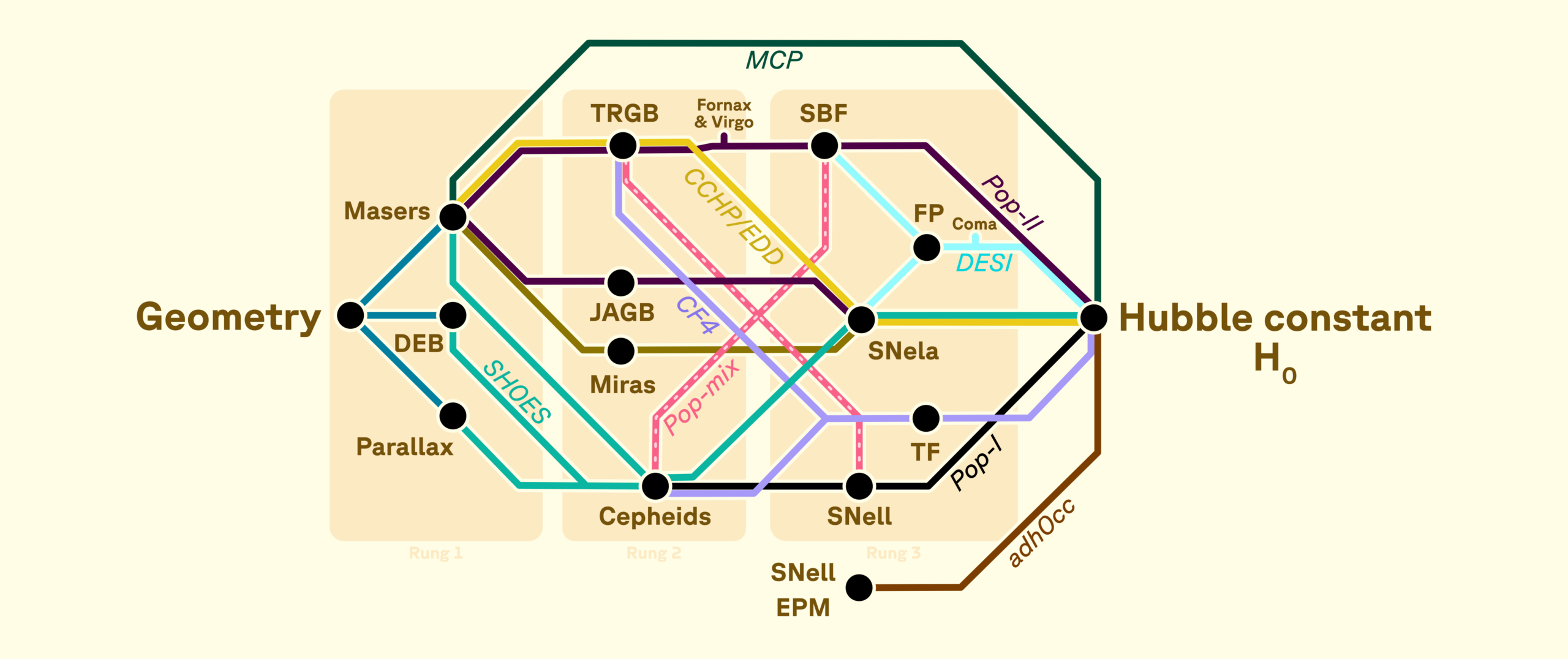
For nearly a century, astronomers have relied on the so-called “distance ladder” to measure the expansion rate of the Universe—the Hubble constant, H₀—by calibrating increasingly distant cosmic objects through a sequence of interlocking steps. This method has delivered tremendous progress, but it also means that uncertainties can propagate along the chain, without the benefit of spreading risk or sharing the load. The H0DN Collaboration therefore adopted a broader mathematical framework, replacing a single measurement path with a Local Distance Network that links many distance indicators simultaneously.
Rather than depending on any single measurement path, the network connects a wide range of independent and overlapping distance indicators – including Cepheid variables, the Tip of the Red Giant Branch (TRGB), Mira variables, megamasers, Type Ia and Type II supernovae, surface brightness fluctuations, the Tully-Fisher relation, and the Fundamental Plane – into a single, coherent analysis.
Crucially, the network explicitly accounts for shared uncertainties and correlations between methods through full covariance weighting, allowing the consistency of the entire system to be assessed transparently for the first time.
“This isn’t just a new number for H₀,” the collaboration notes, “it’s a community-built framework that brings decades of independent distance measurements together, transparently and accessibly.”
Robust, transparent, and community-driven
Nearly 40 experts in distance measurements and cosmology, representing a wide range of institutions and methodological backgrounds, participated directly in the ISSI workshop, with additional contributors joining remotely. Before any calculations were carried out, participants voted on the set of first-rank distance indicators, gold standards for defining a baseline solution, along with predefined variants to test robustness.
The network analysis shows that:
- Independent distance indicators are mutually consistent within their stated uncertainties and with no outliers
- No single method or indicator dominates the final result.
- Removing or replacing key components – such as Cepheids, TRGB, or Type Ia supernovae – produces only minor changes in the inferred value of H₀.
To encourage scrutiny and reuse, the collaboration is releasing open-source software and data products, allowing anyone to reproduce the analysis, explore alternative assumptions, or incorporate future measurements as new data become available.
Implications for the Hubble tension
With its unprecedented precision and internal consistency, the new local measurement remains in significant disagreement with values inferred from observations of the early Universe under the assumption of the standard ΛCDM cosmological model. The reported H₀ differs by approximately 5–7 standard deviations from recent determinations based on the cosmic microwave background and baryon acoustic oscillations.
Rather than pointing to a specific flaw in any single measurement technique, the distance-network result broadens the basis of the local measurement of the Hubble constant.
“This work effectively rules out explanations of the Hubble tension that rely on a single overlooked error in local distance measurements,” the authors conclude. “If the tension is real—as the growing body of evidence suggests—it may point to new physics beyond the standard cosmological model.”
A foundation for future precision cosmology
Beyond delivering the most precise direct measurement of the Hubble constant to date, the Local Distance Network establishes a flexible and extensible framework for the future. With a flood of new observatories, improved calibrations, and additional geometric distance anchors becoming available, they can be integrated into the network to further refine our understanding of cosmic expansion and provide clues about the resolution of the Hubble tension.
“This work shows that explanations invoking a single overlooked systematic in local distance measurements are increasingly difficult to sustain,” the authors conclude. “If the tension reflects real physics, it may indicate new ingredients beyond the standard cosmological model or require a reassessment of early-Universe inferences.”
The study also highlights the role of ISSI Bern in fostering open, collaborative, and methodologically rigorous science that bridges traditional disciplinary and institutional boundaries.
The full paper will appear in Astronomy & Astrophysics. Upon acceptance, the analysis code will be made publicly available via GitHub and the Astrophysics Source Code Library.