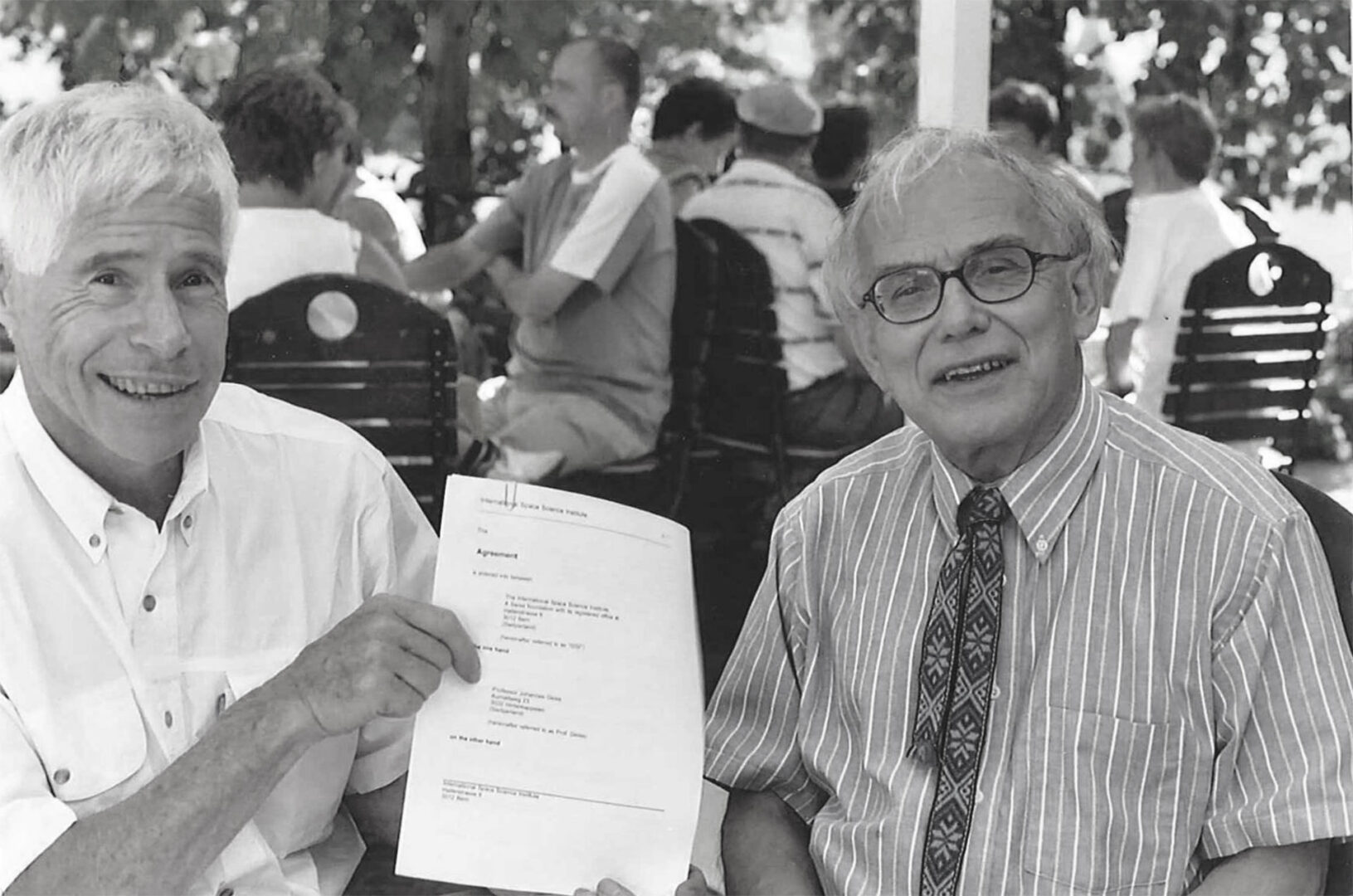
The scientists who participate in ISSI are mainly unaware that there is a Board of Trustees, but in fact the Board controls ISSI. This is a common and necessary model, Trustees overseeing an institute. This model, however, does not lend itself naturally to the uniqueness of ISSI, an organization with very few employees, and a very much larger number of unpaid researchers, whose productivity is the purpose of the institute; an organization, located at the University of Bern, but charted to be a truly international organization; an organization whose leaders are intended to be scientists of international stature, with demonstrated leadership skills, and thus credentials exceeding that of the leaders of the Board of Trustees. I was appointed to the Board of Trustees in 2003, at the beginning of Roger’s term as Executive Director, and served until 2022. Roger, like Johannes before him, encountered challenges with the ISSI Board of Trustees. To help Roger, the Trustees who supported him formed the Jack’s Club, which met for dinner in the Jack’s Brasserie in the Schweizerhof on the night before the Board meeting, sometimes to commiserate about actions that the Board of Trustees had or was about to take; sometimes to strategize how detrimental actions could be avoided. The Jack’s Club continued for many years after Roger’s term as Executive Director.
Roger-Maurice Bonnet’s leadership at ISSI: Greater Impact with International Teams
Roger Bonnet’s approach to managing ISSI was the same as his approach to ESA Science, make the organization more influential, more comprehensive. He introduced the concept of Teams, small groups of international scientists, meeting at ISSI, attacking focused problems. There was a fitting juxtaposition. The ISSI workshops resulted in the ISSI books, which were intended to be a summary of the current state of a particular field of research. An ISSI Team was to advance some aspect of a particular field of research. ISSI Teams were very popular with the international science community, and participation in ISSI grew three-fold during Roger’s tenure as ISSI Executive Director.
There were other initiatives as well. ISSI’s mission was broadened to include Earth Science. Young scientists were recruited and supported. All of this, the Teams, the new subjects, the young scientists, made ISSI a vibrant place, and raised the question whether ISSI had outgrown its Hallerstrasse premises. In searching through my files to write this In Memoriam, I came across a memo summarizing the results from a “Brainstorming” discussion, Roger’s favorite approach to planning, on April 21, 2011, on how to deal with ISSI’s need to expand. The conclusion was that “the intimacy of the ambiance of ISSI, the access to and enjoyment of the city of Bern, the breadth of the scientific program, the integrity with which it is conducted, the scientific products, all result in a very satisfied clientele”, and to change this, to larger facilities, with more participants, perhaps not as conveniently located, “may imperil the success of ISSI”. The memo went on to say that the so-called “franchise model should be considered, in which ISSI charters and exercises control over other branches of ISSI in locations around the world.” The memo also provided advice on where and where not to locate a franchise, and how to insure ISSI control. The result of all this discussion was ISSI-Beijing.
Johannes Geiss had the inspiration for ISSI, a unique organization, where the scientists of the world gather to make scientific progress through the sharing of ideas, consolidating knowledge, advancing understanding. Roger Bonnet built ISSI into a more vibrant, more comprehensive, more impactful organization: The destination of choice for the world’s space scientists who are seeking progress, the best way possible, through international cooperation.
Roger Bonnet had a career-long ambition to encourage international cooperation in space research. ISSI was just one manifestation of this ambition. An important compliment to his work at ISSI was COSPAR. He was elected President of COSPAR in 2002, the year before he was appointed ISSI Executive Director. He served two terms until 2010.
During Roger’s Presidency of COSPAR, ISSI became an Associated Supporter of COSPAR, providing in-kind support of staff for COSPAR meetings, an arrangement that existed for many years after Roger’s Presidency. When you consider the other Associated Supporters of COSPAR, e.g., the Chinese Academy of Science, major industries like Airbus, this was excellent recognition of the importance of ISSI.
There was also a connection between my career-long ambition to encourage international cooperation and Roger’s. In the second term of Roger’s Presidency of COSPAR, he held a Brainstorming discussion, the result of which is there should be a COSPAR Scientific Advisory Committee, which I agreed to Chair. This placed me into a leadership position in COSPAR. In 2014, I ran for President of COSPAR, with Roger’s strong support. In fact, my campaign office was in ISSI, and it was a successful campaign. I was elected the first American President of COSPAR at the COSPAR Assembly in Moscow.
Roger Bonnet and I shared common goals of encouraging international cooperation in space research. We had mutually supportive adventures together in pursuit of our common goals. I greatly respected him and he was my friend. And I will miss him.
by Len A. Fisk
Thomas M. Donahue Distinguished University
Professor Emeritus of Space Science, University of Michigan
ISSI Board of Trustees Member (2003–2022)