




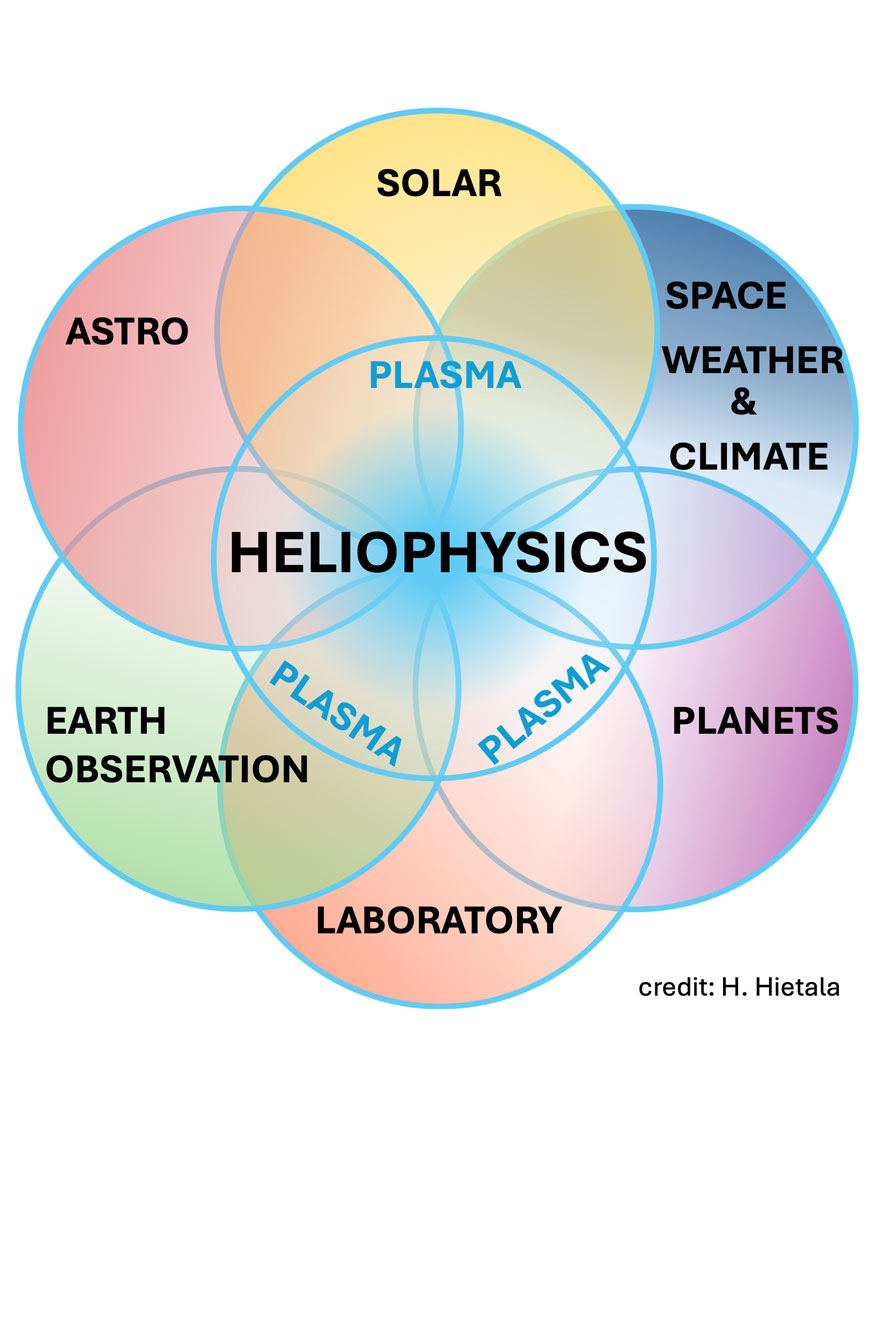
Europe hosts a large and highly active community of scientists working in the broad domain of Heliophysics. This broad discipline addresses plasmas in the regions of space and atmosphere influenced by the Sun and solar wind. However, this community has historically been fragmented, both geographically and thematically, which has limited the potential for strategic coordination, collaboration, and growth. This has recently prompted a grass-roots community-building effort to foster communication and interactions within the European Heliophysics Community (EHC). This white paper outlines the motivation, priorities, and initial steps towards establishing the EHC, and presents a vision for the future of Heliophysics in Europe. As a crucial first step of this endeavour, a dedicated EHC website is now available: https://www.heliophysics.eu/ (last access: November 2025).

As climate change intensifies, adaptation is essential. This Perspective explores how space-based Earth Observation (EO) data can support tracking progress under the Paris Agreement's Global Goal on Adaptation. Focusing on agriculture, biodiversity, extreme events, and health, it highlights EO’s strengths and challenges. The paper offers recommendations for integrating EO in indicator development, drawing parallels with the Sustainable Development Goals and emphasising the need for standardised, operational EO-based adaptation indicators.
This is a critical moment in the history of Earth: humans are ending 3.5–3.8 billion years of relative isolation of the terrestrial biosphere from interaction with its cosmic environment1,2, and may now leave lasting physical, chemical, biological, and unforeseen impacts beyond Earth. Crewed missions, alongside technological advancements in the new space age — such as miniaturization and the use of artificial intelligence — accelerate this trend. Decisions with potentially far-reaching cosmic consequences are being made. Hence, there is an urgent need for action.

Potential climate tipping points pose a growing risk for societies, and policy is calling for improved anticipation of them. Satellite remote sensing can play a unique role in identifying and anticipating tipping phenomena across scales. Where satellite records are too short for temporal early warning of tipping points, complementary spatial indicators can leverage the exceptional spatial-temporal coverage of remotely sensed data to detect changing resilience of vulnerable systems. Combining Earth observation with Earth system models can improve process-based understanding of tipping points, their interactions, and potential tipping cascades. Such fine-resolution sensing can support climate tipping point risk management across scales.
A new era of lunar exploration has begun bringing immense opportunities for science as well. It has been proposed to deploy a new generation of observatories on the lunar surface for deep studies of our Universe. This includes radio antennas, which would be protected on the far side of the Moon from terrestrial radio interference, and gravitational-wave (GW) detectors, which would profit from the extremely low level of seismic disturbances on the Moon. In recent years, novel concepts have been proposed for lunar GW detectors based on long-baseline laser interferometry or on compact sensors measuring the lunar surface vibrations caused by GWs. In this article, we review the concepts and science opportunities for such instruments on the Moon. In addition to promising breakthrough discoveries in astrophysics and cosmology, lunar GW detectors would also be formidable probes of the lunar internal structure and improve our understanding of the lunar geophysical environment.
The ISSI Forum on “Ground and Space Astronomy: Challenges and Synergies” took place on November 18 and 19, 2021, at ISSI Bern. The rationale behind this topic is the fact that fully achieving all scientific objectives of many space and many ground-based surveys increasingly relies on the combination of space data and ground-based observations. This is the case for ESA space missions aiming to characterize extrasolar planets, like Plato, but also for Galactic studies with Gaia, or cosmological missions like Euclid.
This Forum Tipping Points in the Earth’s Climate was held online last month (26-29 January 2021) and brought modellers and the remote-sensing community together to discuss how Earth observations can contribute to our understanding of tipping elements in the climate system and help with early warning of change.
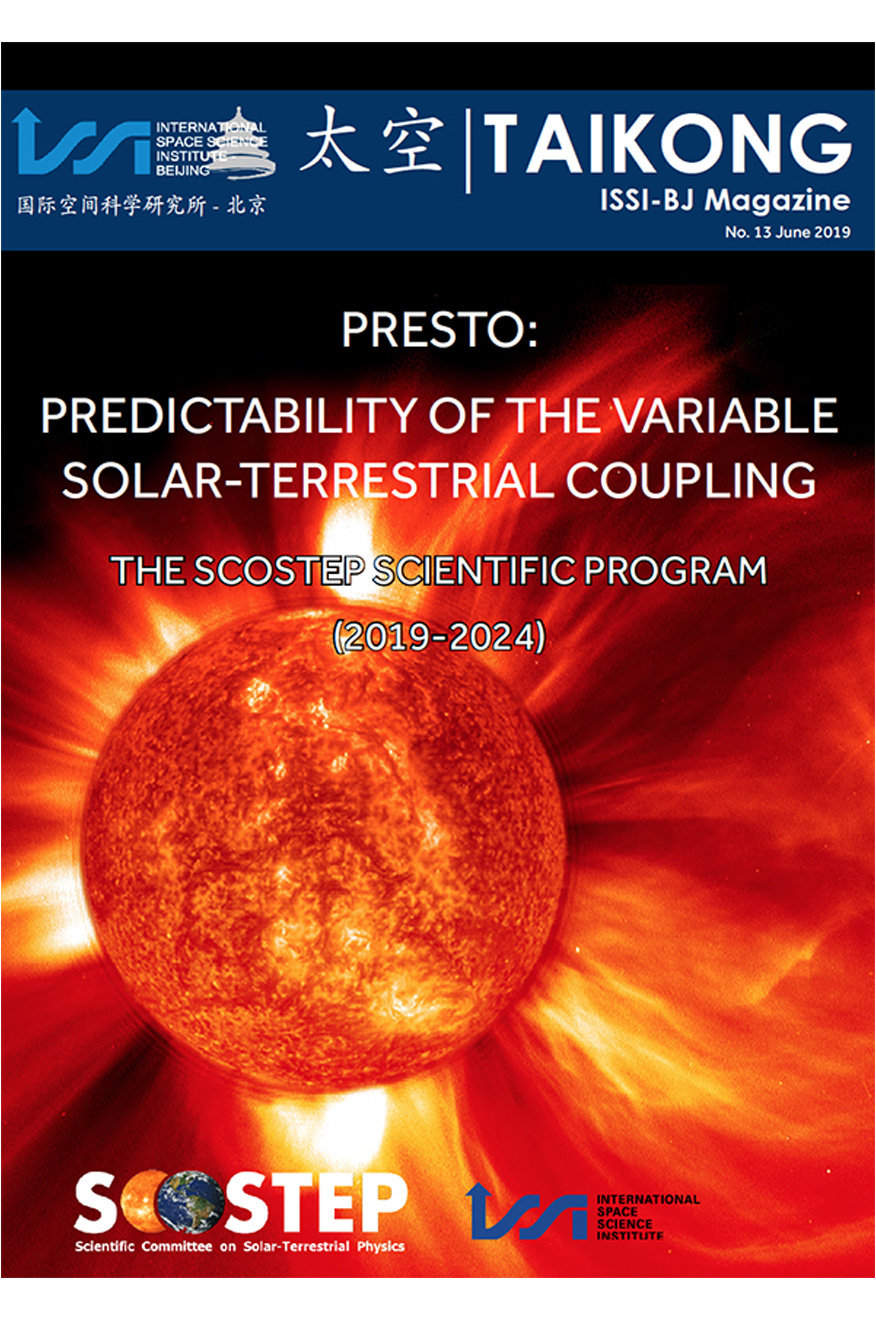
Special Taikong Issue No. 13 (June 2019) resulting from the Fora held ISSI-BJ (2018) and ISSI (2019)
This paper (published in Advances in Space Research, October 2019) resulted from the 2nd Forum on "Small Satellites for Space Science (4S)" held in April 2018
We present the preliminary results of a foresight exercise initiated by the Air and Space Academy (Toulouse, France) and jointly implemented by the Europlanet Research Infrastructure project of the European Union and by the International Space Science Institute (ISSI).