




Public talk by Prof. Ed Hawkins and an expert round table.
November 26, 2026, at 17:00 CET
The Moon is our nearest neighbour, and the only other planetary body humans have ever set foot on. We have been exploring the Moon via manned and robotic missions for more than half a century, but there are still many parts of its history that we cannot explain. Given the relatively small size of the Moon, it is reasonable to assume it cooled down very quickly and has been geologically ‘dead’ for much of its history. However, a huge number of observations refute this assumption. Magnetic measurements on Apollo samples highlight that the Moon was able to generate its own magnetic field that was, for a time, even stronger than Earth’s magnetic field today. New chemical data from the Chinese Lunar Exploration Program suggests the Moon has had active volcanism, with lava flowing onto the surface for more than 3 billion years. In this talk, the speaker will explore some newly revealed links between the volcanic and magnetic history of the Moon and discuss how the upcoming Artemis missions can help us to understand more about some of the Moon’s most mysterious behaviour.
A few days ago, there was a new team at ISSI. With 21 members, it was a rather large one — yet everything felt familiar. There was excitement about being away from everyday routines, animated conversations over free mugs and stickers, and a buzz of anticipation in the air. But this time, there was a first: ISSI was welcoming a local class of ten-year-olds, attending the fourth year of Swiss primary school.
Bern’s Astronomy on Tap event sponsored for the first time by ISSI lit up the Stellwerk on November 18, 2025, and not just because nearly 100 people packed into the venue beneath the Grosse Schanze. With every seat filled and glasses raised, the atmosphere was primed for an evening where cutting-edge space science met tasty drinks and great company.
In her engaging TEDxVitosha presentation, Dr. Rosita Kokotanekova, Planetary Science Discipline Scientist at ISSI, poses a compelling question: Could we catch a comet before it hits Earth? She frames this not as science fiction, but as a bold, plausible scientific mission with transformative potential.
If you’ve recently had a coffee in ISSI’s common area and felt the Moon watching you—or spotted an alien contemplating a galaxy—you’re not imagining things. You’ve encountered the latest addition to our institute: a stunning, wall-sized space science mural, hand-painted by our very own C. Baier and Fabio Crameri.
In March 2025, the International Space Science Institute (ISSI) in Bern hosted an inspiring week-long workshop titled “What’s under the H₀od? Towards Consensus on the Local Value of the Hubble Constant”, bringing together some of the world’s leading cosmologists to tackle one of astronomy’s most puzzling problems: the rate at which the universe is expanding. Among them was Prof. Dr. Adam Riess, Nobel Prize-winning astrophysicist from Johns Hopkins University, who co-convened the workshop and also gave a widely attended public lecture as part of ISSI’s outreach series.
The Surprising Expansion History of the Universe
March 25, 2025
18:30 CET
University of Bern,
Institute für exakte Wissenschaften,
Hörsaal A 006,
Sidlerstrasse 5, 3012 Bern
‼️ Due to the speaker’s request, the talk will not be live-streamed or recorded. We appreciate your understanding and look forward to your participation in person.
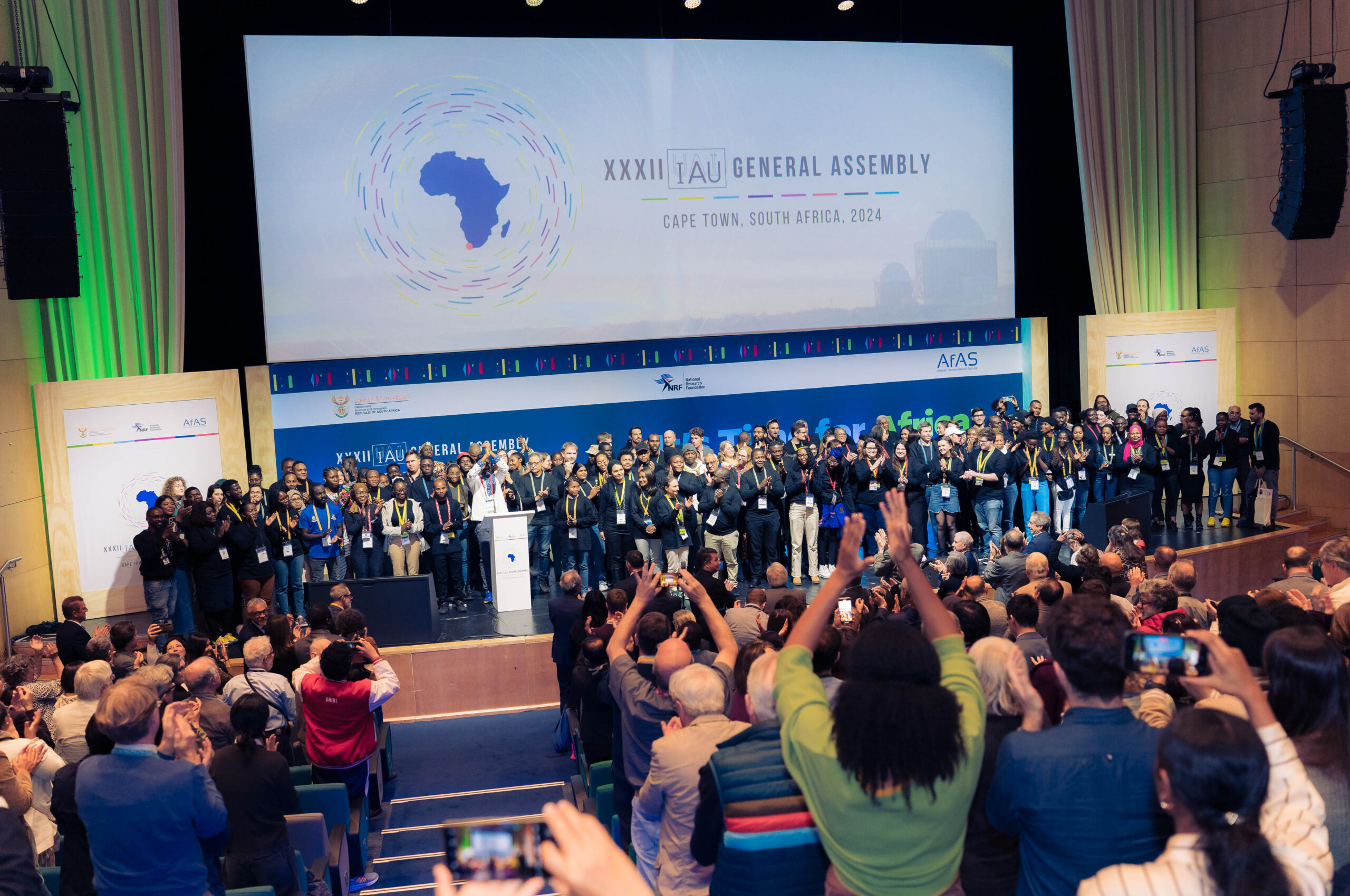
The world of astronomy assembled in South Africa🇿🇦, for the first time.
ISSI was there, too.