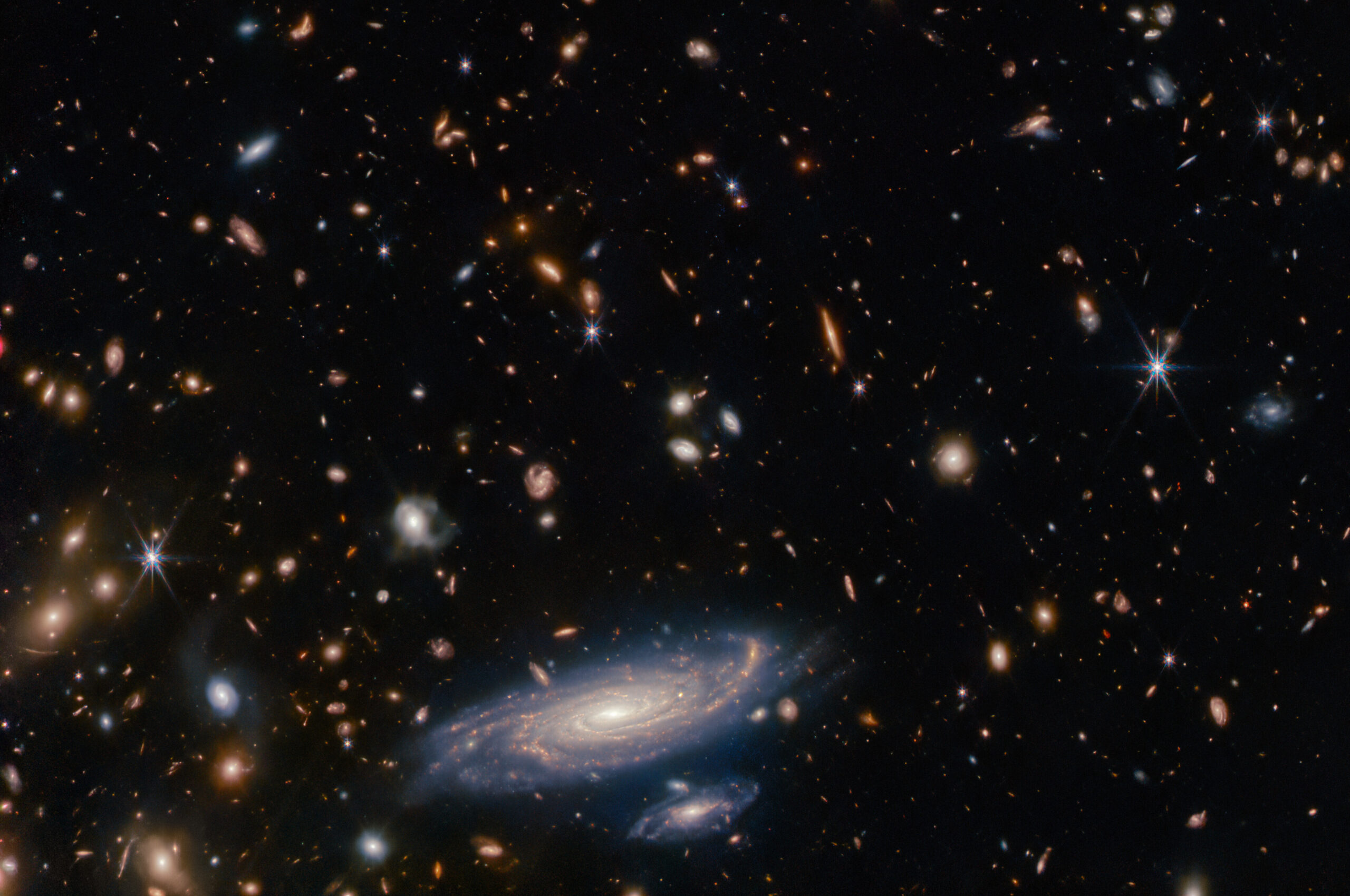





There is a moment, astronauts say, when something inside them quietly rearranges itself.
It usually happens a few minutes after launch, once the rocket’s noise has faded and the window fills with the curve of the Earth. Suddenly, home is not a country, a city, or a garden. It is a single, luminous sphere, wrapped in a paper-thin atmosphere, hanging in absolute silence and absolute dark. There are no borders up there. No visible flags. Just one shared, to us fragile planet.
Scientists and philosophers have a name for this experience: the Overview effect.
A highly unscientific investigation into the most artistic corner of Hallerstrasse 6
Every year, somewhere around a thousand scientists pass through ISSI’s doors. Astrophysicists fresh off a redshift argument, climate scientists still smelling faintly of glacier, heliophysicists who insist the Sun is “actually very calm, most of the time”, and planetary scientists quietly convinced that whichever moon they currently study is the most interesting object in the Solar System. They come from every continent, in every discipline ISSI covers, for Workshops (or even Breakthrough Workshops), Fora, International Teams, and Working Groups. They argue, they calculate, they discover, they eat far too much Swiss chocolate in the coffee corner.
And then, before they leave… almost all of them pick up a pen.
Because tucked in the corner of ISSI sits an unassuming but quietly legendary object: the ISSI Guestbook. Page after page, team after team, year after year, our visitors leave behind a signature, a note, a doodle, or, in a small number of magnificent cases, something that can only be described as fine art with a fountain pen.
Naturally, the people who watch this happen most closely are ISSI’s own staff. And naturally, they have opinions.
On August 12, 2026, the Moon passed directly between the Earth and the Sun, casting its shadow across a narrow path on the surface of our planet. To experience this once-in-a-lifetime event, I set off from ISSI in Bern, and headed south-west towards northern Spain. The closer I got to the eclipse path, the more it became clear that I was far from being the only one with this idea. Spain was attracting eclipse chasers from across Europe and beyond, all converging towards a relatively narrow strip of land where the Moon would completely cover the Sun.
A few days ago, there was a new team at ISSI. With 21 members, it was a rather large one — yet everything felt familiar. There was excitement about being away from everyday routines, animated conversations over free mugs and stickers, and a buzz of anticipation in the air. But this time, there was a first: ISSI was welcoming a local class of ten-year-olds, attending the fourth year of Swiss primary school.
When the International Space Science Institute (ISSI) hosted its very first workshop in 1995, cross-disciplinary international collaboration was far less commonplace. Yet, heliospheric science was already thriving, and among the participants was a young scientist named Eberhard Möbius. Nearly three decades later, as ISSI hosts the workshop “Multi-Spacecraft Observations and their Importance for Understanding Particle Dynamics in the Inner Heliosphere”, Möbius is back — this time alongside Dr Emma Davies, a first-time ISSI participant representing the next generation of space scientists.
Their shared presence offers a natural bridge between the past and the future of space science. It is a living example of how careers, ideas, and collaborations evolve shaped by the ISSI ecosystem.
If you’ve recently had a coffee in ISSI’s common area and felt the Moon watching you—or spotted an alien contemplating a galaxy—you’re not imagining things. You’ve encountered the latest addition to our institute: a stunning, wall-sized space science mural, hand-painted by our very own C. Baier and Fabio Crameri.
What have White Dwarfs, Neutron Stars, and Black Holes in common? – Accretion disks! For a Swiss who has stirred cheese in multiple occasions and settings, a direct comparison to fork-induced cheese swirls seems obvious. As Alexandra Veledina from University of Turku in Finland points out, the spinning matter of the two might look similar but the physics involved are fundamentally different. Veledina was one of the lead conveners of the ISSI Workshop on Accretion Disks bringing together more than thirty international experts to discuss and sharpen our understanding about them that we developed over the past fifty years.